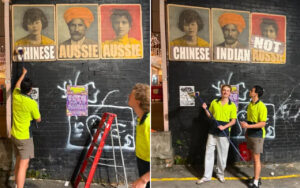
A uniparty parliamentary committee has reviewed the Labor government’s listing of the White Australia Party as a prohibited hate group and found the ban was justified.
On May 15 the White Australia Party (WAP) was banned under new laws passed by the major parties in response to the Bondi Islamic terrorist attack, and the listing was the subject of a review by the Parliamentary Joint Committee on Intelligence and Security (PJCIS) which began in late June.
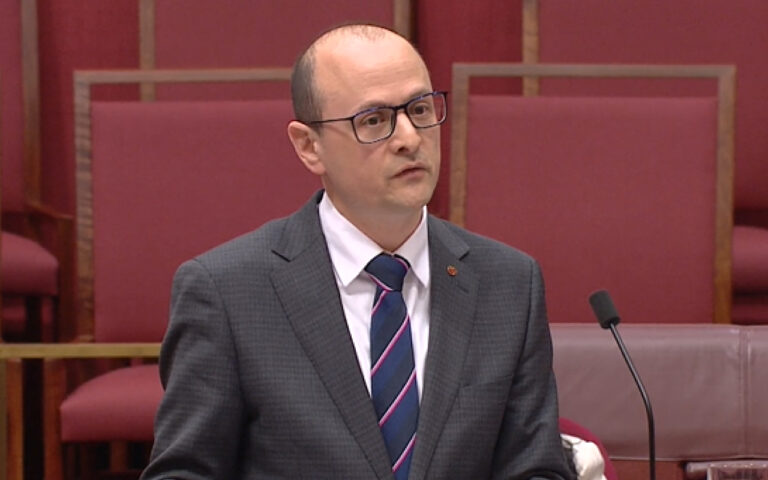
The Chair of the Committee, the Labor Senator Raff Ciccone, announced the results of the review on Tuesday, and said the PJCIS had “carefully examined the evidence before it, including stakeholder views”, and decided to support the listing.
“Based on the evidence, the Committee is satisfied that White Australia has engaged in conduct constituting hate crimes and that the listing is necessary to protect Australians from harm,” he said.
“For too long, organisations like White Australia have been able to spread hate and create a pathway for others to engage in violence. Australia will not tolerate groups that promote hatred, normalise extremist rhetoric and put the safety of Australians at risk.”
Civil liberties groups and legal experts have warned the prohibited hate group legislation is open to abuse, can be used to ban any political party, and “abolishes” liberal democracy.
The Committee allowed public submissions on the review, and many urged the PJCIS to disallow the listing, including the Free Speech Union of Australia, which warned the laws allowed the government to “decide, in private and on secret advice, which political associations citizens may join, fund and vote for”.
“I think it’s undemocratic to ban a political party. It would be wise to let the people determine the fate of the White Australia Party via the voting process and not an unconstitutional banning process,” said one.
“I oppose the proposal to prohibit the White Australia Party from registration as a political party. My opposition is not based on agreement with the party’s policies, but on the principle that, in a democracy, Australians should generally be free to form political parties and allow the voters to determine whether those ideas deserve public support,” said another.
“Listing a fledgling political party as a hate group so as to prevent them from running in a democratic election is a dangerous precedent, no matter the beliefs of such a party, and should not be done, ever,” said a third.
A submission from a mother-of-three said the listing had “very real collateral consequences for women and children whose connection to a community have been social, supportive and familial rather than anything potentially harmful or unlawful”.
“Before the proscription, I had found a community that gave me a sense of support, familiarity, and practical connection that is otherwise very difficult to find. At events, my children had friends, familiar faces, and a safe-feeling environment where there were always extra adults around and other mothers nearby,” she wrote.
“When the organisation was proscribed and the community disbanded, that network disappeared overnight. I lost a source of daily encouragement, support,
practical advice, and social connection with other mothers. My children lost their friendships, outings, and a familiar social environment.
“In practical terms, we now live much more isolated lives because many environments are either isolating or simply too difficult and risky to manage alone with three children.
“I ask the Committee to consider the human impact of these decisions on women and children who may be left socially isolated when communities collapse. If the state chooses to use a power as serious as proscription, it should at least acknowledge that there may be innocent family members and children affected by the fallout.”
The listing instantly made it illegal to direct, be a member of, recruit for, train, fund or support the group, punishable by up to 15 years’ imprisonment.
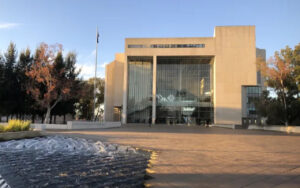
The WAP has launched a legal challenge to the prohibited hate group laws in the High Court, and whether the laws are constitutionally valid will be decided in September.
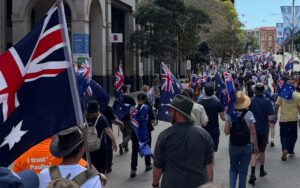
The case has ignited a nationwide debate about freedom of speech, and patriotic Australians are planning nationwide protests on August 30 against the Labor government’s “hate speech” laws, ongoing efforts to censor the internet, and the hate groups legislation.
Header image: Mr Ciccone announcing the results in parliament (Australian Parliament).