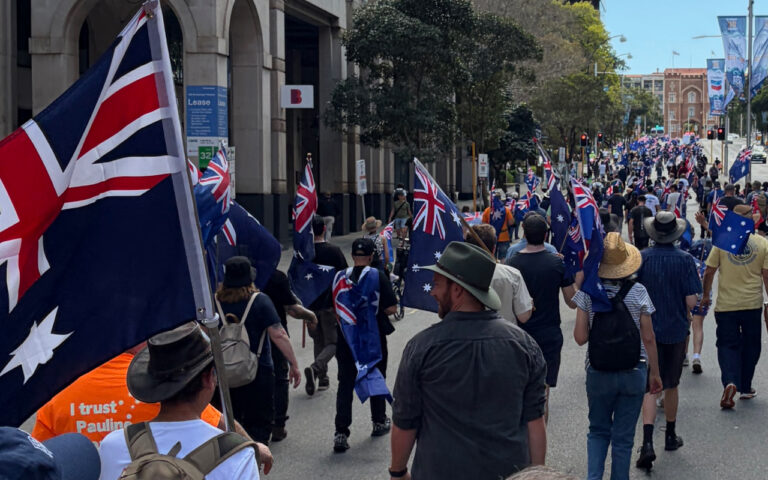
Last weekend I had the pleasure of participating in the fourth March for Australia in my home city of Perth. Several thousand patriots and other supporters of free speech marched all the way from the foreshore, up St George’s Terrace to our state parliament. Nationalists, libertarians and Christians shared the stage, giving speeches in defence of free speech and our political rights. It was easily the largest right-wing political gathering in Western Australia since the original March for Australia a year ago – a river of Australian flags down Perth’s busiest street. From what I have heard, it was the same in every other capital city of Australia.
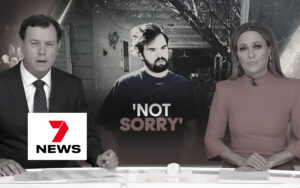
Yet if your only source of information was the mainstream media and Australia’s politicians, you’d be forgiven for thinking that nothing at all happened last weekend. In contrast with the massive press coverage and political denunciations that preceded last year’s rallies, all we got were a few minutes of the nightly news running the hackneyed trick of conflating violence by communist counter-protesters in Melbourne with the peaceful marches by patriots. What’s more, One Nation politicians from across the country all mysteriously found their diaries fully booked this time around (though their supporters still turned out). Those who had been boasting about their unbreakable commitment to free speech in January suddenly found themselves with nothing to say to a rally explicitly defending that very concept.
Why has the establishment been so keen to avoid talking about the rally, even to denounce it? Why did One Nation suddenly pull out of an event which had arguably provided them with the biggest grassroots platform that their party had ever had?
The obvious answer is that they didn’t want to talk about the topic of the rally – the prohibited hate group legislation that was rushed through parliament in January, and which is due to have its constitutionality decided before the High Court next week.
For the prohibited hate group laws are not merely another odious addition to Australia’s panoply of “hate speech” and counter-terrorism laws. They are instead arguably the biggest alteration to Australia’s political system since Federation, and the end of Australia’s democratic system as we have known it. They also happen to be blatantly unconstitutional, which is why the government refuses to discuss the laws, even to publicly defend them. The establishment is desperately hoping that it can change the entire basis of how politics works in Australia without the voters noticing.
While the legislation ostensibly deals with groups involved in “hate crimes”, “politically motivated violence” and “communal violence”, the definitions are left so vague and the remit made so broad that it could conceivably capture almost any political organisation in the country.
There is no judicial element to the laws, as no one need actually be found guilty of a “hate crime” for a ban to take place. Nothing needs to be proved in court. What’s more, the conduct captured need not even have been illegal at the time. There is no independent judgement that the given standard of proof has been met, or any avenue of appeal. It is purely an executive choice made by the Director-General of Security (an unelected public servant) and the Minister for Home Affairs (a politician).
If they decide together that a given organisation’s activities could “increase the risk of politically motivated violence, or of the promotion of communal violence”, and that said activities “indicate a risk that the organisation may advocate for or engage in politically motivated violence, or engage in the promotion of communal violence, in the future” and that it has at some point “advocated engaging in conduct constituting a hate crime [even if no crime actually took place]” then it can be banned as “reasonably necessary to protect the Australian community from social, economic, psychological or physical harm”. It is subjective at every point; loaded down by words and phrases like “risk”, “in the future”, “reasonably necessary” that have no legal definition. Or indeed any objective definition at all outside of the heads of Tony Burke and Mike Burgess.
The impact that these laws have is not limited to the members of organisations that are directly banned. Real politics inevitably offends someone, and political outcomes will inevitably cause some individual or section of the community to experience “social, economic, psychological or physical harm”. There are frequently policy decisions in which one group will be a clear winner, and the other will lose. It is not uncommon that the dividing line between winners and losers falls precisely along the lines covered by Australia’s new “hate crime” laws – race, national or ethnic origin.
Therefore every political party and advocacy group in Australia now operates under the shadow of a potential ban. They are only one confected “hate crime” accusation away from being permanently dissolved by force. This is especially true of those talking about issues that the government doesn’t want discussed, such as immigration, multiculturalism, national identity, religion and controversies about the state of Israel. They will almost certainly engage in self-censorship, if the alternative is state persecution.
Vague laws invite selective enforcement. In effect, two men in Canberra (one of whom has never been elected) now have total veto power over politics in Australia. Burke and Burgess alone get to decide if you get to participate in the political process or end up in prison.
On its own this would be bad enough. Unfortunately the laws are not merely limited to abolishing free speech, but also destroy freedom of association. The secondary, and far more corrosive, effect of the laws is to create two different classes of Australian citizen with different political rights. If you are a member (or even perceived to be a member) of a prohibited hate group then you permanently lose your right to political association. You don’t need to have been personally found guilty of committing a crime, and there is no avenue of appeal. Unlike a prison sentence, it never expires. Unlike a fine, there is no way to pay off the debt. There is no way to regain your rights, ever. It doesn’t matter if you spent a single week as a member of the group five years ago, or if you were the leader of the group right up until the day it was banned.
A few examples will suffice. It’s worth bearing in mind that each of these offences attracts a maximum of 7 to 15 years’ imprisonment. If you join any political organisation that also has former members of a prohibited hate group, then that group risks being banned as an alias of the banned group. If you continue to meet privately with friends who were previously part of a prohibited hate group, you are potentially committing a crime. If you speak favourably of a prohibited hate group, then you are potentially committing a crime. If you decide to exercise in a public park with your friends, then you risk committing a crime. If you decide to attend a public protest which other former members of the group are attending then you are potentially committing a crime. There is effectively no safe way to directly engage in the political process without the threat of years in prison.
The laws amount to extra-judicial punishment, permanently inflicted on a new underclass created by government fiat.
What explanation has the government provided as to why it needed to abolish democracy? Aside from vague posturing from Burke and others about the need to combat “extremism” and “hate”, the only reasoned justification for the laws was the one that the government was forced to provide in response to the High Court challenge mounted by former White Australia Party leader Thomas Sewell. It can be found here.
As far as I’m aware, The Noticer is the only Australian news outlet to have reported on the contents of this High Court submission. The reason for this, no doubt, is that the arguments made in the submission are both poorly reasoned and shockingly at odds with Australia’s democratic political culture.
Other writers for this publication have already commented on the submission’s absurd appeal to unenforceable UN treaties, and the direct quotation of a former Soviet NKVD officer on the desirability of banning “Hitlerite” organisations. What hasn’t yet been widely noted is that the core argument lacks any kind of internal coherence and makes easily disprovable claims about how the laws are being currently enforced.
The submission opens with the argument that the laws are required in order to specifically ban “neo-Nazi” organisations, and then engages in a lengthy argument about how Australia is required to ban “neo-Nazi” organisations because of unenforceable international treaties. Yet a mere ten pages later the Commonwealth argues that “whether a person contravenes Div 114B depends upon the capacity in which, and the manner in which, that person acts – not upon the content of anything that person says. Part 5.3B does not impose a burden upon ‘communication which target[s] ideas or information’, or upon the ‘character’ of such ideas or information, but at most upon ‘an activity or mode of communication by which ideas or information are transmitted’.” It then goes on to claim that the laws are actually “content-neutral: it is not directed to any particular points of view, or communication about specified topics, nor can it be described as ‘discriminatory’ and that “Part 5.3B does not allow, in any way, proscription based on the political persuasion of the ideas or class of ideas that are espoused by the group in question”.
Three pages later the government swings back to arguing that “the suppressed premise of the Plaintiffs’ submission is that Nazi ideology is legitimate political speech. It is not. History demonstrates why it is not. And the Australian Constitution does not require that space be made for neo-Nazi organisations – at the ballot box or otherwise”.
The government’s lawyers are apparently arguing, in time honoured 4chan fashion, that there is no restriction of political speech and association occurring, but if there is, then it’s actually a good thing.
The arguments only get lazier. On page 13 the government argues that the White Australia Party is not engaged in protected political speech, but rather “the communication routinely engaged in by the First Plaintiff and its members … is independently unlawful under provisions the validity of which are not challenged”. But if the allegedly illegal activities of the WAP are covered by other laws, then there’s apparently no point in the prohibited hate group laws existing in the first place.
Not only are shoddy arguments made about the justification for the laws, but also their impact. According to the government’s lawyers, these are desperately necessary laws that simultaneously have no impact on the people they’re targeting.
It is argued that “members and officers of a prohibited hate group remain free to make, participate in, or receive political communication as individuals so long as the communication is not independently unlawful. Similarly, they remain free to regroup and reorganise to pursue political aims or participate in political debate as a new organisation or by participating in some other existing organisation, so long as the organisation does not satisfy the criteria for specification as a prohibited hate group”.
Given the White Australia Party was banned immediately after attempting to register as a federal political party, this seems like a rather loose interpretation of how the laws are actually applied. Particularly as the government submission explicitly stated that one of the main reasons why it was legal to suppress the WAP is that it is not a registered political party in the first place.
Some of the submissions made by the state governments to the case are even more bizarre and concerning. For instance, the West Australian government’s submission appears to deny the right to freedom of association entirely, with the claim on page 15 that “individuals do not have any right to be members of an organisation … the implied freedom of political communication (and allied freedom of association) is not a personal right”. This would surely be a surprise to the citizens of Western Australia.
Anyone who reads the submissions of the Commonwealth and state governments will be able to find even more cases of absurdities and blatant contradiction, and I won’t bore the reader further. It is an attempt to defend the indefensible; to phrase neo-Bolshevik ideological repression in the language of liberal democracy and civil rights. The laws didn’t last two days of political scrutiny when the government rammed them through parliament in record time in January, and they wouldn’t last five minutes of public scrutiny now if they were openly debated. Hence the establishment’s friends in the mainstream press have done all they can to keep them out of the minds of voters.
Obviously, the government does not want to make its justification for tyranny public, but why has One Nation decided to stay silent?
Unfortunately, it’s clear at this point that One Nation is a lost cause. Its leaders proved pathetically eager to sell themselves out to the uniparty at the first whiff of mainstream political success. The situation will only get worse as One Nation absorbs the Chamber of Commerce types and ex-lawyers who are increasingly jumping ship from the Liberal Party. They were perfectly happy to use March for Australia as a platform, and now that it has served their purpose they are just as happily discarding it in exchange for a pat on the head from the mainstream media and the political establishment. Their opposition to the uniparty was never rooted in genuine disagreement over policy, but only over their own exclusion from power. Now that they’ve been given a seat at the table, no matter how small, they have become proponents of everything they once opposed, whether it’s mass immigration or state promotion of homosexuality. Why would we assume that their commitment to free speech was any different?
As the laws were passed with the enthusiastic consent of the Liberal Party (thanks Andrew Hastie!), and One Nation now refuses to touch the issue, our only immediate hope to see these laws reversed is the High Court challenge scheduled for the 8th and 9th of September. It is no exaggeration to say that Australia’s future as a free, democratic country rests on the decision.
If the laws are struck down (as they should be) then the government’s treachery towards its own citizens will be exposed for all to see, and a legal precedent will be created to safeguard our rights from the ever-encroaching managerialist state.
But the High Court may have become so politicised that it rules that the grossly unconstitutional is in fact constitutional. There is simply no way of knowing ahead of the date.
Regardless of the outcome, those of us who marched last Sunday can at least be proud that we took a stand against tyranny while we were still free to do so.
Header image: Patriots march for free speech in Perth last weekend (Mitch Sutton).