The Trump administration has raised “serious concerns” about the Australian government’s controversial Digital Duty of Care regime, warning it will facilitate censorship, encroach on free speech, and unfairly burden American companies.
The US Embassy in Canberra responded to the proposal in a statement on Tuesday, which was issued while Prime Minister Anthony Albanese is in New York to promote his government’s efforts to regulate technology at the United Nations General Assembly.
An exposure draft of the Digital Duty of Care legislation was released earlier this month, with consultation ending on Tuesday, and a final version is expected to be introduced to parliament later this year.
Labor claims the regime will protect Australians from “harmful content” online, but it would allow a minister to make regulations adding new categories of “harm”, enable the government to fine social media companies $100 million, and would force the tech giants to allow users to “opt out” of algorithms.
INTERNET CENSORSHIP: Watch Communications minister Anika Wells explain that she gets to decide what will be banned on the internet. Watch pic.twitter.com/whvjk27hKc
— Sandy Yang (@SandyXiaotong) September 9, 2026
The US Embassy said it was concerned about how the government would designate what constitutes “harm”, that the bill would force platforms to change their algorithms to suppress expression that should be protected, and that the laws would result in platforms “defaulting to pre-emptive censorship” to avoid liability.
“A framework that empowers governments to enforce vague definitions of ‘harm’ risks becoming a mechanism for viewpoint-based censorship, as platforms will be incentivised to over-moderate speech that should be protected to avoid regulatory penalties,” the US government said.
“Such a framework also risks reducing the reach of independent journalists or other voices whose content touches on sensitive or controversial topics that platforms may pre-emptively demote to comply with overbroad safety mandates.
“If Australia compels platforms to aggressively filter content in algorithmic feeds to satisfy a government mandate, and such filtering draws in protected speech, the effect on a disfavoured speaker or media source’s reach would not be meaningfully different than outright removal.
“The US government would likely consider such a measure as facilitating censorship.”
The Trump administration also warned the regime would have effects beyond Australian borders, and would therefore impact American social media users.
“We ask that Australia withdraw any plans to mandate that platforms algorithmically suppress content based on ambiguous government-defined safety criteria,” it said.
“If other jurisdictions adopt their own, potentially conflicting duty-of-care mandates, platforms could face incompatible design requirements that are not technically or commercially scalable to implement in parallel. Thus, creating pressure toward a lowest-common-denominator or most-restrictive-jurisdiction outcome.
“The US government has made clear its opposition to foreign measures that result in extraterritorial censorship of protected speech by Americans online.”
In a section on economic concerns, the US government said the plan could “affect Australia’s reputation as a jurisdiction that enables innovation”, and pointed out that the eSafety Commissioner already has “significant takedown powers”.
The US government also included a list of questions, including on who will define “foreseeable harm”, on the effects on content creators and independent journalists, about the involvement of eSafety, and about whether the government will use the laws to suppress speech it disagrees with.
“What safeguards will ensure that any biases and preferences of Australian government officials and regulators do not influence platform design in ways that disadvantage independent or minority-viewpoint speech?” it asked.
While unveiling the legislation earlier this month Mr Albanese acknowledged it may face opposition from the US, but said Australia would act in its own interests.
Earlier this week, Nationals MP Bridget McKenzie, who broke with the Liberal Party to vote against Labor’s “hate speech” laws in January, said she was against the regime, and said the government was “dressing up ‘care’ for government sponsored censorship”.
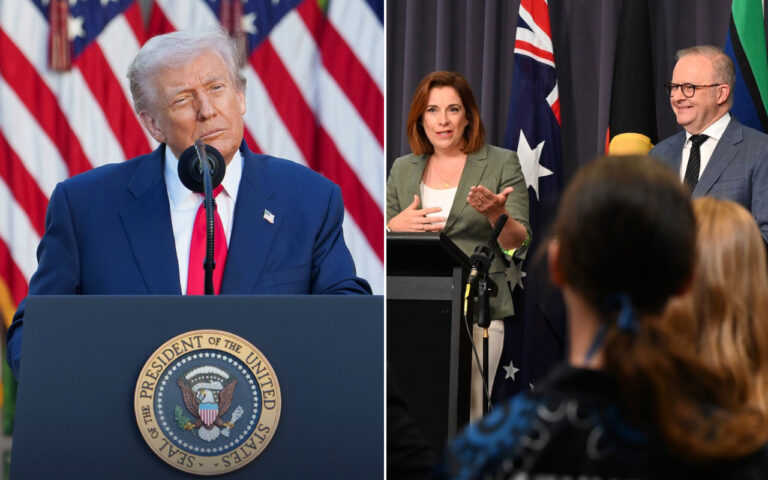
Header image: Left, US President Donald Trump (White House). Right, Communications Minister Anika Wells and Mr Albanese (Facebook).