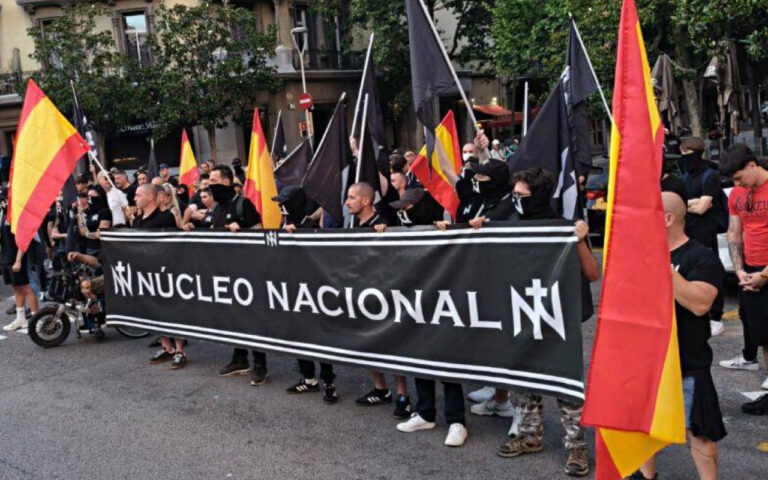
Just weeks before a snap general election where immigration is the dominant issue for voters, Spain’s left-wing pro-migration minority government has made the move to shut down a nationalist group.
On November 12th 2026, the Spanish authorities placed a series of restrictions on Núcleo Nacional – a radical nationalist organisation – citing weapons violations, the promotion of hate crimes, and an alleged plot for a violent uprising. An investigating judge in the northern city of Gijón ordered the immediate suspension of all of Núcleo Nacional’s activities while prosecutors evaluate whether to dissolve the group entirely. As part of this suspension, the organisation has been forced to close its offices in Madrid, Burgos, and Valladolid, has had all of its assets and bank accounts frozen, and the court also ordered that all of the organisation’s social media accounts were to be blocked. This move to effectively freeze all of the activities associated with Núcleo Nacional followed a number of arrests and raids that took place earlier in the same month when Spanish police conducted a nationwide operation, searching the group’s Madrid offices and other locations. Spanish officers arrested 14 members of the group – including prominent far-right figure Isabel Peralta – and seized more than 20 firearms, ammunition, and other illegal weapons.
At first, this sounds extremely serious: firearms, illegal weapons, multiple arrests, and talk of a plot that involved a violent uprising. However, the timing of these raids and following court orders must also be considered, as Spain is heading toward a snap general election that will take place on November 29th 2026. This snap election was triggered when the Spanish parliament was dissolved after the conservative People’s Party, the anti-immigration Vox party, and the pro-independence Catalan party Junts voted down the current left-wing government’s emergency measures to address Spain’s housing crisis on October 2nd 2026. But there is another issue that will play heavily on voters’ minds at this election – one which not only vindicates the position of nationalists, but may well drive many Spanish voters to cast their ballot for anti-immigration candidates and parties. Earlier in 2026, the left-wing coalition government led by Pedro Sánchez enacted the largest amnesty for illegal migrants that has ever taken place in Europe. What’s more, this amnesty was not approved via normal means, but was enacted by completely bypassing a parliamentary vote on the issue.
In April 2026, the Spanish government finalised what it termed its “mass regularisation amnesty programme”, and on April 16th 2026 applicants could begin officially registering with the programme, which was scheduled to run up until June 30th 2026. The amnesty was open to any migrant that had arrived in Spain before January 1st 2026, providing that they had lived in Spain for five months or more and had a clean criminal record. Initially, the government estimated that there would be approximately 500,000 applicants – however, this number rose to almost 1,270,000 by the time the programme was brought to a close at the end of June. This immediately proved that the government was vastly underestimating the number of illegal migrants living and working in Spain. Whether this was deliberate under-reporting, or whether the Spanish government had lost control of the borders to such a degree they genuinely didn’t know how many illegal migrants were living in Spain, remains to be seen. But one thing is for certain: the amnesty granted a pathway for over a million illegal migrants to remain on Spanish soil.
The successful applicants were all granted a one-year renewable work permit. But this swamping amnesty was neither popular, nor did it have the democratic support of the Spanish parliament. In fact, as Sánchez’s left-wing coalition government does not have a majority in parliament, the amnesty was originally blocked by other parties and, as such, the legislative drive ended up stalling and coming to a complete halt. This is when the left-wing coalition government took unprecedented action. Under Spanish law, the main collective decision-making body of the executive branch, known as the Council of Ministers, can amend existing immigration regulations via a Royal Decree without requiring a parliamentary vote. The Council of Ministers is essentially what the British would refer to as the cabinet, meaning the decision to ratify the amnesty was made entirely by Prime Minister Pedro Sánchez and a small group of his closest and most influential ministers. It is also important to note that a Royal Decree does not actually involve the King, who has a purely ceremonial role; instead, such a decree is entirely controlled and passed by the Council of Ministers.
Government officials, including Migration Minister Elma Saiz, stated that using a decree allowed them to cut through the legislative delays and quickly address labour market shortages and tax revenue needs. This use of the Royal Decree was being framed as a way to break the parliamentary deadlock – a necessity according to the government, as it allowed them to pass legislation within a deeply divided parliament that was ruled by a minority government. However, this was not exactly the whole truth, as the decision to pass the amnesty was heavily influenced by the far-left party Podemos, which had aggressively pushed for the executive action in exchange for supporting the minority government on other policy fronts. This was not simply a case of ignoring the democratic process, but it was also an example of a far-left minority party influencing major policy against the will of the Spanish public. In parliament, the centre-right People’s Party and anti-immigration Vox party leaders both condemned the move as an undemocratic abuse of executive power and an unsustainable pull factor for illegal migration – an opinion that has since been vindicated.
The parties which opposed the amnesty and the way it was brought into force argued that bypassing lawmakers on a policy affecting over a million people undermined the democratic process and denied members of parliament a vote on a pivotal issue. The Vox party were joined by other sympathetic members of the Spanish parliament who opposed the bill, and they immediately filed an appeal with Spain’s Supreme Court seeking to suspend the decree. However, despite this pushback, in May 2026, the Supreme Court rejected an emergency suspension, allowing the application process to continue while at the same time leaving the decree open to future legal scrutiny. The Supreme Court appeared to have sat on the fence – despite refusing to block the amnesty, they did allow those who filed the appeal a pathway to challenge it further in the future. Crucially though, this allowed the amnesty to continue, causing outrage from large sections of the general public and even from some trade unions.
The amnesty became a polarising issue, and while MPs in parliament had attempted to block it through the courts, other groups took several different courses of action. Immigration office workers and some Spanish trade unions who had expressed anger over the sudden rollout of the scheme, going as far as to warn of an administrative collapse, went on to threaten strike action because processing offices were understaffed and unable to handle the surge of applications which far exceeded initial estimations. What’s more, a wave of anger also erupted amongst the general public, and large-scale anti-immigration protests were organised all across Spain, with activists from the now-suspended Núcleo Nacional delivering leaflets, partaking in many of the larger protests, and arranging their own smaller public events. Alongside Núcleo Nacional, both the conservative People’s Party and the anti-immigration Vox party managed to mobilise huge numbers. Outrage over the amnesty was so widespread that hundreds of thousands attended demonstrations across the country, with individual city events attracting between 20,000 and 180,000 protesters.
Those who partook in these demonstrations were not only opposed to the largest amnesty in European history, but also to the effects it might have on future migration into Spain. Immigration is always driven by both “push” and “pull” factors. “Push” factors are pressures that displace migrants or drive them from their homelands, such as war, famine, or poverty. “Pull” factors are the incentives that attract migrants to European countries, such as generous financial benefits, housing allocations, and free medical care. Opponents of the amnesty argued that such an act would not only alter the demographic balance in Spain, but would also act as a powerful “pull” factor that would attract more migrants to Spanish shores. It wouldn’t be long before those who made this claim would be vindicated – as in July 2026, around 70,000 to 80,000 migrants crossed from Morocco into the Spanish North African enclave of Ceuta by swimming around border breakwaters or breaching fences in what can only be described as a swamping wave of migrants.
But this wasn’t the first time that a large wave of migrants had forced their way into Ceuta – nor was it the first time such a crisis had put Núcleo Nacional’s Isabel Peralta in the legal crosshairs. In May 2021, around 8,000 to 10,000 migrants entered the Spanish North African enclave from Morocco over a period of two days from May 17th to May 18th. As a result, the Spanish nationalist group Bastión Frontal – of which, at the time, Isabel Peralta was a prominent leader – staged a demonstration outside the Moroccan Embassy in Madrid. Isabel gave an impassioned speech where she stated that “it is not migration, it’s an invasion” before going on to claim “we are suffering unprecedented racial substitution.” Isabel Peralta was then promptly arrested for delivering that speech, and in April 2025 the Provincial Court of Madrid found her guilty of the crime of provocation to discrimination and hatred under Article 510 of the Spanish Criminal Code. Then in July 2026 – following the large-scale border crossings into Ceuta that took place just months earlier in July – an appeal ruling by the Superior Court of Justice of Madrid also rejected her defence that she was simply critiquing the Spanish government’s border management and upheld her conviction.
Both courts decided that by using a megaphone to shout “death to the invader” and labelling Moroccan migrants as an “invasion” who were driving an “unprecedented racial substitution”, she was intending to demean the Moroccan community, attack their human dignity, and encourage violent behaviour during a moment of high public tension. Due to this, Isabel was sentenced to a year in prison, although prosecutors had initially requested a three-and-a-half-year sentence, and was handed a six-month daily fine totalling €1,080 along with the requirement to pay for the legal cost of the trial. Isabel was also disqualified from the right to stand for public office for the duration of her sentence, and the court also ordered the removal of any videos of the May 2021 speech which had been posted on the internet or on social media. However, under Spanish law, first-time offenders sentenced to two years or less in prison typically have their custodial sentences suspended, meaning they remain free under differing conditions; as a result, Isabel did not actually serve any time in jail.
Yet at the very same time the Superior Court was upholding her conviction in July 2026, Isabel’s words about an “invasion” and a resulting “replacement” seemed almost prophetic, as the 2026 migrant wave that overwhelmed Ceuta was so large it actually outnumbered the Spanish citizens living in the enclave. What’s more, it wasn’t just Isabel and Spanish nationalists who criticised the Spanish government for their role in attracting this migrant wave. In fact, 22 out of the 27 European Union leaders signed a joint open letter on August 1st 2026 that criticised Spain’s migration policies immediately following the Ceuta border surge. Spearheaded by Italy and Denmark, the letter blamed Spain’s mass amnesty for acting as a “pull factor” for illegal migration into the EU. The leaders argued that granting legal status to large numbers of undocumented migrants creates the perception that “the illegal entry of a migrant can become a legal stay”, encouraging further crossing attempts across Europe. Signatories warned that mass crossings threaten the EU’s external borders and stated they were prepared to reintroduce temporary internal border controls within the Schengen passport-free zone to stop secondary movement. Further to this, they demanded an urgent meeting of EU interior ministers to coordinate border enforcement and return policies.
However, while European leaders debated the summer fallout from Ceuta, the 2026 migrant incursion into the enclave wouldn’t be the only large-scale and coordinated attempt by illegal immigrants to enter a Spanish autonomous community. By the midpoint of November 2026, over 9,000 migrants had illegally entered the Canary Islands following a spike of 6,194 arrivals in October. On Saturday November 14th 2026, Spanish maritime rescue services helped 1,580 migrants to land safely ashore, a figure that broke the previous single-day record which was set in November 2020. The majority of the migrants come from Senegal, Gambia, Mauritania, and Guinea, arriving for the most part on the smallest and westernmost island, El Hierro, which has a population of around just 12,000 people. In total, around 17,000 migrants have landed on El Hierro this year, straining local healthcare, accommodation, and emergency services. But the way these migrants are treated is very different to those who illegally entered Ceuta. Whereas the left-wing Spanish government have actually managed to capture the vast majority of Moroccan migrants that entered Ceuta, immediately deporting them back to Morocco, the opposite is true for those arriving in the Canary Islands.
Whereas Ceuta is a North African Spanish enclave that is actually physically connected to Morocco and has a land border with the Muslim nation, the Canary Islands are situated off the coast of North-West Africa and can only be accessed by boat. As a result, large wooden boats that are often filled with over 100 migrants make the crossing. Just as is the case in the UK, the Spanish coastguard often assist the migrant-filled boats on the journey, with many of the boats setting off from countries situated on the bulge of West Africa. The Spanish coastguard then guides the boats safely to the nearest port situated on the Spanish islands. Once migrants arrive on small islands like El Hierro, authorities register them at the port and move them to larger islands – such as Tenerife and Gran Canaria – or fly them to state-run reception centres on the Spanish mainland. What’s more, the Sánchez government passed an emergency declaration on November 10th 2026 which allocated €15.2 million to both fund transfers to mainland Spain for migrants arriving in the Canary Islands and to expand the amount of accommodation available in order to house them when they arrive.
When illegal migrants are moved from the Canary Islands to mainland Spain, they are initially placed in temporary facilities while their legal status or asylum claims are processed. If an asylum claim is rejected and the person is not from a country with an active repatriation agreement, authorities often issue a formal expulsion order. However, because Spain cannot legally detain migrants indefinitely or force countries without return treaties to accept them, many remain in Spain without legal status once their temporary shelter period ends – eventually disappearing and no doubt hoping for another amnesty that will grant them leave to remain. This is further complicated as many of the migrants declare themselves as unaccompanied minors, meaning that the Spanish government treats them as vulnerable children and places them under state protection, which guarantees them broad rights to care, housing, and legal residency which may not be immediately accessible by adults that enter Spain illegally.
As the situation in the Canary Islands has reached boiling point, residents of La Restinga and across El Hierro have taken to the streets to demand urgent government action. This culminated on Sunday November 15th 2026, as dozens of La Restinga residents gathered outside a meeting held by Spain’s Territorial Policy Minister, Ángel Víctor Torres, to protest the ongoing immigration pressure. The arrivals of large numbers of illegal migrants into the Canary Islands that have taken place throughout 2026 have also helped fuel demonstrations on the mainland that have gathered pace throughout late summer and into autumn. Throughout August, mainland cities saw sustained street demonstrations and sporadic clashes at reception centres and makeshift camps as anger over the April amnesty and July border crossings in Ceuta reached a peak. In September 2026, tens of thousands of people protested across major cities in mainland Spain – including Madrid, Málaga, and Valencia – against the government’s migration policies and handling of the Ceuta border crisis. Finally, in late October 2026, thousands of women – many travelling from Ceuta – marched through central Madrid demanding stronger border security and public safety measures following the mass border invasion.
With tension over immigration rising, a huge wave of public outrage over an amnesty that was forced through legislative channels in an undemocratic manner, and several high-profile swamping waves of illegal immigration into Spanish autonomous territories, the upcoming general election looks as if it will be fought largely over the issues of border control and migration. But mass immigration also feeds into the other issue that forced this election: Spain’s housing crisis. As mentioned earlier, the general election was triggered when a number of parties in the Spanish parliament voted down the minority government’s proposals to deal with the housing issues plaguing the country. But crucially, these issues – which include a scarcity of social housing and rapidly increasing rents and house prices due to the fact that demand for housing is vastly outstripping the supply – are again driven by mass immigration. A rising population, driven largely by a surge in international arrivals and foreign workers crossing Spain’s borders, has significantly increased the overall demand for residential space. This heightened demand has outpaced the supply of new-build homes, pushing up home sale prices and rental rates across the country as a whole.
With public anger mounting over both of these failures, the minority government found itself on the back foot ahead of the November ballot. So now, in the run-up to this snap general election, where the two most important issues are immigration and housing, the Spanish authorities are pursuing an unprecedented clampdown on a nationalist group, which has resulted in the group being forced to suspend all its activities before election day. While Núcleo Nacional and its political party Noviembre Nacional were not standing in the forthcoming election and had instructed their supporters to vote for Falange Española, activists affiliated with the group were in the process of helping in the planning of a number of widespread anti-immigration demonstrations due to take place before the ballot on November 29th, which would have been highly critical of the minority government. As a result, the fact that the Spanish courts have ordered a suspension of all activities associated with Núcleo Nacional could be extremely convenient for Pedro Sánchez and the Spanish government, as the group is estimated to have around 100,000 supporters nationwide.
Further to this, such a well-publicised suspension of a nationalist group this close to an election will of course taint the entire anti-immigration movement, allowing the press, the media, and the left-wing government to conflate anti-migrant sentiment with violence and criminality. However, as of yet, none of the accusations have been proven in court, and both Isabel Peralta and Núcleo Nacional have maintained their innocence and claimed that the actions are merely another example of political persecution by the Spanish state. Speaking to reporters outside the court in Gijón, Isabel Peralta’s lawyer, Guillermo Calvo, asserted that his client held valid firearm licences for all the guns seized at her home in Pinto. Calvo also went on to explicitly distance Isabel Peralta from the other 13 detainees, stating he could only vouch for the legality of Peralta’s permits. What’s more, when discussing the intercepted phone call in which she spoke about shooting rioters in Paris – a recording prosecutors pointed to as evidence of an alleged violent uprising – her defence clearly explained that the remarks were merely hyperbole and venting to her boyfriend rather than an actionable terrorist plot or genuine preparation for an attack.
Isabel Peralta’s legal team have been clear: the weapons she held in her home were all legally owned and correctly registered, and the wiretaps used in order to frame her as a violent terrorist by authorities were clearly nothing more than off-the-cuff comments made in a moment of anger following violent riots that saw historic European cities being looted by migrant gangs. This assertion was backed up by an unnamed spokesman for Núcleo Nacional who released a video on social media following the court-ordered suspension that declared, “They won’t beat us” and “We have been victims of persecution and political repression”. In the same video statement, Núcleo Nacional accused the Spanish justice system of political bias and selective enforcement. The group argued that authorities were aggressively targeting nationalist activists at the start of the election campaign while showing leniency in judicial investigations affecting Prime Minister Pedro Sánchez’s Socialist Party, which has been subject to numerous accusations of corruption, influence-peddling, and institutional mismanagement.
Núcleo Nacional maintains that it is a legitimate political association – having formally registered with Spain’s Interior Ministry in 2024 – aimed at a “national awakening” and peaceful street activities rather than an unlawful criminal gang. Ultimately, however, that looks as if it may well be decided by the Spanish courts. But one thing cannot be denied: the timing of the raids appears very coincidental – and if the Russian state had ordered a number of large-scale raids and arrests which resulted in the suspension of an opposition group just before a major election, then it would undoubtedly be something that the Western press and media would have been far more interested in covering. Time will tell if those arrested are in fact charged or found guilty in a court of law. However, one thing is indisputable: Spain’s left-wing minority coalition government have supported numerous pro-immigration policies and gone out of their way to push through pro-migrant legislation without the correct parliamentary oversight – something that has been deeply unpopular with the Spanish public.
The question is: are these arrests a justifiable legal response to a genuine threat, or is this a trumped-up case that is yet another example of a left-wing government that has been mired in corruption, again abusing its power in an attempt to influence an election?
This article was originally published on Mark Collett’s Substack, and is republished by The Noticer with permission. Mark is one of the most censored activists in the world – please subscribe to his posts.
Header image: A Núcleo Nacional demonstration (Telegram).