A recent ABC piece by Gary Nunn caught my eye. A dual citizen British-Australian writer, Nunn is an LGBTQ advocate and a veteran Guardian contributor. If that bio makes you worry about where the argument is headed, your instincts are spot on.
His central claim is that masculinity is broken. In short, it must be rehabilitated and redefined before it can be considered socially acceptable.
Nunn is wrong. Masculinity is not toxic. It never was. Blaming masculinity for broader societal problems is like blaming fire for arson instead of the person holding the match.
This deliberate fraud has become the primary intellectual scam of the last twenty years. It has been laundered through elite institutions from Sydney to Washington, until a generation of gullible partisans mistook an aggressive PR campaign for unassailable gospel.
The irony is impossible to miss. The author spends thousands of words insisting we should reject simplistic stereotypes while constructing one of the broadest stereotypes imaginable. Masculinity itself is portrayed as inherently hazardous and requiring constant supervision by experts, charities and academics before it can safely exist in society.
The term “toxic masculinity” has been doing the rounds for years, repeated by allegedly serious institutions with the mindless cadence of a cult chant. No one bothered to ask whether the diagnosis holds water. It doesn’t.
There are toxic fathers. There are toxic mothers. There are toxic bosses. There are toxic girlfriends. There are toxic politicians. There are toxic human beings.
Masculinity is no more toxic than electricity. It can power hospitals or power an electric chair depending on who is using it.
In 1912, as the RMS Titanic slipped beneath the freezing Atlantic, hundreds of men stepped back to let women and children reach the lifeboats first. They went down with the ship because to them, manhood meant mastering complete terror in the service of total strangers. A century later, our elite social commentators look at that exact brand of self-sacrifice and diagnose a psychiatric condition.
The most frustrating aspect is that the article identifies real problems before blaming the wrong culprit. Male suicide is devastating. Disillusionment among men is real. Drug abuse, isolation, fatherlessness and social disconnection are genuine crises. But none of those horrors emerged because a teenager watched a cage fight on Saturday night or grew up believing a man keeps his promises.
The author’s own father illustrates this perfectly. He wasn’t destroyed by masculinity. Rather, he was a complicated man struggling with aging, retirement, purpose, and personal pain. Millions of men sharing his exact temperament navigate that same psychological wasteland every single year without detonating their lives or dragging their families into the wreckage.
Then comes the magical phrase: “Expansive masculinity.”
Whenever modern social theory pairs adjectives like “healthy”, “positive”, “inclusive” or “expansive” with ordinary human behaviours, it’s best to brace for impact.
What does expansive masculinity even mean? Being compassionate. Being emotionally available. Not being a complete sociopath to your friends. Sourdough baking. Who exactly was protesting this? The article carries on like a father embracing his son is a ground-breaking socio-political rebellion, rather than something normal men have done since the Stone Age. The author triumphantly demands a manhood built on “compassion, kindness, and respect”, a magnificent discovery that completely ignores the fact that decent men were practicing it long before anyone started writing long-winded essays. Strong men shed a tear long before psychologists monetised vulnerability.
In 1944, Allied soldiers stormed the beaches of Normandy. They were eighteen-year-old farm hands, mechanics, and clerks who cried in their landing craft, held hands in the dark, and wrote heartbreaking letters home to their mothers. They then stepped out into a wall of machine-gun fire. They lived through absolute horror with deep love for their brothers and unimaginable levels of actual courage. They accomplished all of it without a single academic sitting them down to explain how to manage their feelings.
Even stranger is the article’s treatment of masculinity as infinitely elastic until it includes almost everything except traditional masculinity.
You can be nurturing. Sensitive. Gentle. Emotionally expressive.
Wonderful.
However, when you also happen to prize stoicism, physical toughness, competitiveness, or self-sacrifice without staging a dramatic emotional unboxing in the breakroom, the red flags go up. The circle only expands to welcome traits that make men softer.
Then there is the bizarre assumption that boys are somehow uniquely endangered by expectations while girls receive unconditional affirmation. One father quoted actually says raising girls seems easier because you can simply tell them they can do anything, whereas encouraging boys supposedly “licenses their tendency towards dominance”.
That sentence is rather disturbing.
Imagine being an ordinary ten-year-old boy hearing that message. Your sister gets absolute encouragement. You receive a disclaimer explaining why confidence might be socially hazardous. Then adults wonder why boys increasingly feel alienated.
Perhaps because they have spent years hearing that the very traits associated with their sex require a complete overhaul before anyone can trust them. This has been happening for decades across Australia, Britain, Canada and the United States. Boys are constantly told what not to become before anyone bothers telling them what they should become.
Don’t dominate. Don’t interrupt. Don’t mansplain. Don’t be aggressive. Don’t be emotionally unavailable. Don’t take up space. Don’t be intimidating.
Eventually the lecture itself becomes the identity.
The piece assumes masculinity must first be dismantled before decent men can emerge, when reality suggests the opposite is true. Civilisation has always depended on masculine virtues properly directed. Strength without cruelty, discipline without depravity, confidence without arrogance, sacrifice without resentment.
Those are not contradictions. In truth, they are the very qualities that built families, defended nations, rescued strangers, and raised generations of children.
Masculinity doesn’t need reclaiming because it was never lost. But it does need defending against those who spent years convincing boys that being masculine was something that required an apology.
John Mac Ghlionn is an essayist and cultural commentator who focuses on societal change. He discusses the hidden forces shaping modern life, family trends, and institutional trust.
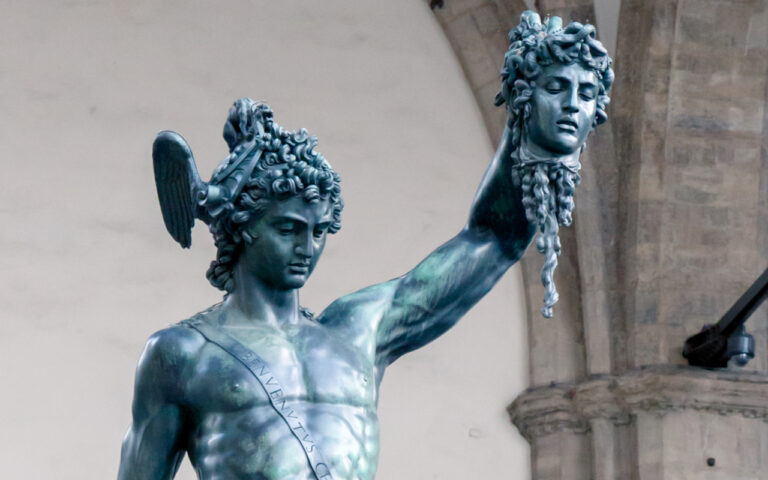
Header image: Perseus with the head of Medusa (Morio – Own work, CC BY-SA 3.0, Link).