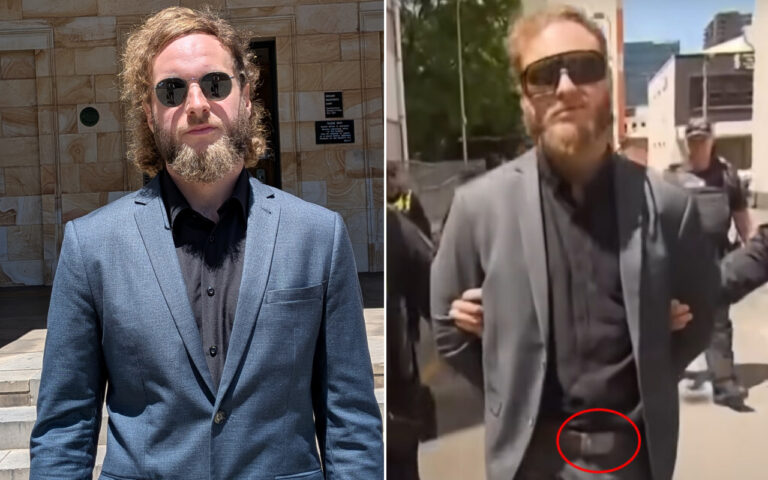
Prominent Australian nationalist Joel Davis has faced trial over a belt buckle with an eagle on it that police allege is a Nazi symbol, almost two years after he was arrested and charged following an Australia Day rally.
Mr Davis, 31, this week represented himself in Adelaide Magistrates Court after pleading not guilty to one count of publishing a Nazi symbol, in a trial that was expected to last five days, but which finished on Tuesday afternoon.
The former National Socialist Network activist argued that the eagle on the belt was not a Nazi symbol, that he honestly did not believe that it was a Nazi symbol, that it was not displayed to the public due to its deterioration and as a result of having a swastika removed, and that he did not think it was illegal to wear.
Magistrate Michael Jandy said he would deliver his decision in early March, citing a lack of legal precedent on the relatively new South Australian laws, and saying he would need “some time” to consider the evidence.
The court heard that Mr Davis was waiting for several then-members of the National Socialist Network (NSN) to be released from custody on January 28, 2025, when he became involved in a confrontation with police, and was accused of wearing a Nazi symbol at the march two days earlier and arrested.
BREAKING ⚠️
Australian nationalist Joel Davis has been arrested for “loitering” outside an Adelaide court where he was waiting for 16 National Socialist Network members to be granted bail, two days after they were locked up over an Australia Day march.
Follow: @NoticerNews https://t.co/5D7rQdEgx9
— N News (@NoticerNews) January 28, 2025
He was taken into the police cells where his belt was removed along with other items of clothing for procedural reasons, at which point police claim a Nazi symbol on the buckle was identified.
Mr Davis was later charged two counts of publishing a Nazi symbol, one for an NSN patch worn at the rally, which was later dropped, and one for the belt buckle.
The court heard it was either an authentic or replica Hitler Youth buckle that was heavily worn, and which had had a swastika and most of the slogan “blut und ehre” (blood and honour) ground off, leaving only an eagle visible along with some of the word “ehre”.
Police prosecutor Chris Brannan argued that the belt buckle constituted a Nazi symbol despite the removal of the swastika and slogan as it was “associated” with the Nazis due to their use of the eagle and its pre-alteration design, and said it only had to be seen by a member of the public for an offence to have been committed.
Several of the arresting officers were called as prosecution witnesses, and all said under cross-examination by Mr Davis that they had not identified the belt buckle as a Nazi symbol on the street or during the arrest.
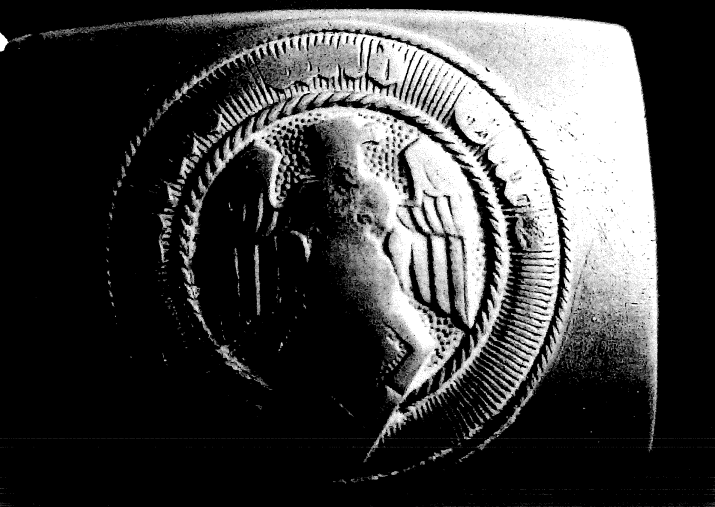
One officer told court he identified the buckle as a Nazi symbol after the belt was removed from Mr Davis and taken outside the cell, and said in cross-examination that he recognised it thanks to briefings on Nazi symbols given prior to the NSN rally, but wasn’t able to recall which specific symbols he had been shown.
A counter-terrorism officer, who said he was part of an operation targeting the NSN during the Australia Day weekend and ordered the arrest after recognising Mr Davis on the street, said he believed another officer had first noticed the belt buckle, but then said in cross-examination it was possible that he identified it first.
The prosecution then called as an expert witness emeritus professor Dr Konrad Kwiet, resident historian at the Sydney Jewish Museum, who testified that he was able to identify the buckle as one produced for the Hitler Youth, or as a replica.
Dr Kwiet told the court the eagle was among many symbols used throughout German history that had been “Nazified” after Hitler came to power, and said the slogan referred to Nazi concepts of racial purity and slavish devotion and obedience to national socialism.
Mr Davis then called as his own expert witness former Macquarie University associate professor Drew Fraser, who told the court the belt buckle had been “de-Nazified” by the removal of the swastika and slogan, and was therefore no longer a Nazi symbol.
He testified that the eagle on the buckle was almost identical to eagles used by the Romans, that eagles had been used as a symbol of Germany for thousands of years, including both immediately before and after the Nazi period, and said similar eagles with swastikas removed could still be seen on buildings in Germany, where the belt would be legal to sell and wear.
Professor Fraser also told the court that the slogan “blood and honour” predated Nazi Germany, and possibly even the First World War, and that it did not have a specifically Nazi meaning.
In cross-examination Mr Brannon put to the witness that he was “whitewashing Nazi history”, which Professor Fraser denied, and said Dr Kwiet could also have been asked if he “demonised” national socialist ideology while on the stand.
Mr Brannon repeatedly asked Professor Fraser if he was a national socialist, and if he espoused or legitimised national socialism, to which the retired academic responded that he was not, and said that his ideology could be described as “Anglo republicanism”.
After submitting his closing arguments in written form, Mr Davis told the court that the one arresting officer who testified that he identified the belt as a Nazi symbol had a “primed opinion”, and that the counter-terror officer was part of a specialised operation focussed on the NSN.
“He knew a whole lot about me, there is a distinction between him and someone randomly encountering me in the street,” Mr Davis said.
“You were targeted,” Magistrate Jandy interjected.
“They were looking for something,” Mr Davis said.
He told the court that the most reasonable explanation for why he was wearing the buckle was because he didn’t think it was illegal, and asked why he would get in an argument with police who were looking for an excuse to arrest him while wearing a Nazi symbol.
Mr Davis concluded by saying that debate during the preceding two days about whether the eagle was a Nazi symbol showed that the prosecution case was not proven.
“Had there been a swastika on the belt, I don’t think we would be having such a long and complicated trial, I think it would be cut and dry, the very fact that there is ambiguity, that is the textbook definition of reasonable doubt,” he said.
Mr Davis is facing about 20 other unrelated charges over his political activism, including for a speech made at an “abolish the Jewish lobby” rally in Sydney, podcast comments, an election leaflet stunt, and an alleged Telegram post about a federal MP for which he spent 133 days in isolation on remand.
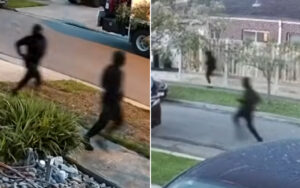
Header image: Left, Mr Davis outside Adelaide Magistrates Court. Right, Mr Davis during his arrest in 2025.