Imagine you’re playing a game of chess against the presiding government.
It’s a team game, meaning your teammates sit behind you deliberating, and you all come to a strategic decision before each move.
You and your team sit on the right side of the picture while the government sits well and truly to the left.
At first you’re doing surprisingly well. Despite having considerably less-resourced teammates, you take both the government’s bishops and lock down its queen.
You’ve got a strategy to win and it’s actually looking good.
But suddenly, your opponent stands up and declares your queen a “hate piece”.
They say you’ve been moving it too abrasively and to make the game more socially-cohesive, your queen should be banned from play.
You look over your shoulder at your teammates, expecting support but they mostly say nothing. A couple of the more timid ones actually admit your opponent has a point.
You watch as your queen is removed from the board while the government’s queen remains right where it was, but it can even move more freely now and with relative impunity.
Your queen was a very valuable piece because it could move more radically, cover the most ground and help shift the game in your favour, so you’re now playing at a ridiculous disadvantage.
It may even be stupid to continue playing at all, seeing as the rules just changed to handicap you into failure while your own teammates won’t even protest it.
This is exactly what happened in Australia, when the government recently banned the far-right out of political existence, through emergency legislation rushed in after the Bondi shooting.
For fear of censorship and the resulting damage to their personal income streams, much of the right-wing community avoided talking about it, and now, prior to the Victorian state election, the ugly consequences of this sudden sabotage and the fundamental lack of collaborative unity on the right are clear.
We’ve got the boomer patrol trying to revive old and weak talking points, rebuilding enemy framework that our radicals destroyed years ago, explaining why they’re not racists, and appealing to state media to provide them with a sense of legitimacy.
We (the right) have our own media now. We don’t need TV news, and anyone who thinks grovelling to journalists is worth it has truly failed to adapt.
Australia’s social-political climate is more radical than ever and I have serious concerns that our centre-right comrades occupying the ground our radicals cleared are woefully ill-equipped to deal with it.
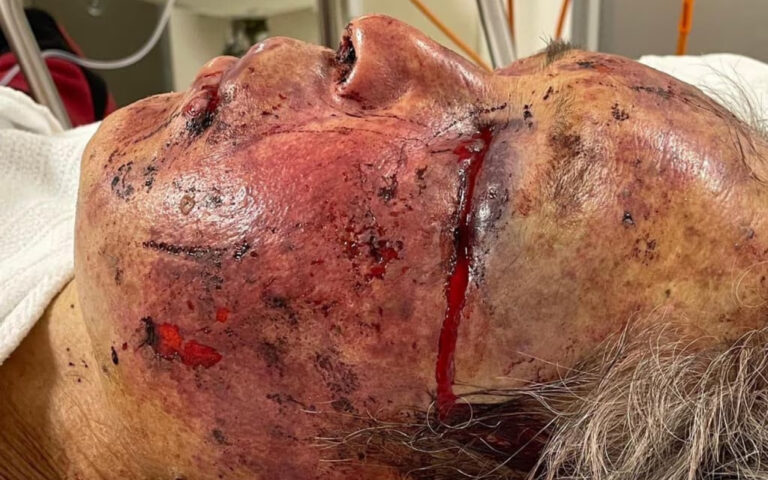
Just two days ago, a One Nation volunteer in Victoria was brutally beaten with a weapon in his own front yard by two foreign nationals on special category visas.
They bashed him so badly he remains in hospital with possible brain injuries, and he was targeted solely because of his support for One Nation.
A new survey has revealed 27.5% of young Australian men believe violence can be justified to advance a cause (up from 19.3%).
Melbourne is covered in “kill Pauline Hanson” graffiti while our historic statues and national monuments are regularly destroyed in the middle of the night by antiwhite vandals.
Students are exposed to radical anti-Australian propaganda as part of their regular curriculum, and subsequently mobilised into anti-racist terror squads focused on One Nation supporters and candidates.
The Albanese government is importing hundreds of thousands of Indians and working hard to appeal to them as a new ethnic voting bloc, which is also visibly replacing Anglo-Australian workers in real time.
Meanwhile, the centre-right seems to be under the illusion that the right’s radicals are unnecessary, as though we’re not locked in a fight for our survival.
To them, this new political environment facilitating a massive popular surge in the far-right is all just coincidental and had nothing to do with the work and sacrifice of the recently outlawed radicals.
In the minds of our moderates, this new opportunity for a restoration of Australian nationalism is due only to the merits of centre-right passivity and is also the perfect chance to sell some merchandise.
Apparently we’re only preparing for more routine elections based on policy, where all we have to do is not be racist and restore the power of narrative framing to state-sponsored news media, so they can tell everyone we’re the good guys while we speak only within the boundaries set by the Albanese government.
Now I’m all for taking things one step at a time, and I fully appreciate the strategy of focusing on what is immediately possible through the electoral process. I’m also not against making some money, so long as it’s not the primary motivation.
I also understand that the game is going to remain rigged until the High Court announces its decision on whether the government can legally ban far-right activism and political options.
But in the meantime, whenever I see people trying to convince their enemies that they are not racist, I feel like banging my head against a wall.
Regardless of where you might position yourself on the right side of politics, stop explaining yourself to people who want to kill you.
To our political enemies there is no way an Australian can prove he’s not racist without denigrating his own heritage and abandoning the principle his nation was founded upon.
When you say “I’m not racist” you don’t just lose, you walk straight back into the confines of your enemy’s pen.
Stop trying to rebuild the language cage we just spent the last four years breaking.
This isn’t just about elections, it’s a fight for our survival.
Header image: The injuries suffered by the One Nation volunteer (GoFundMe).