An Australian man has won a $300,000 payout after police unlawfully seized his firearms and gave false information to have him put into involuntary mental heath detention where he was forced to take psychiatric drugs for four days.
Printing business owner Michael Camilleri was awarded damages in the NSW District Court last week after Judge Andrew Scotting found that police trespassed, carried out an illegal search and seizure, falsely imprisoned him, and carried out a malicious prosecution in order to cover up their own misconduct.
The court heard that two NSW Police officers, Senior Constable David Richards and Constable Andrew Dalton, turned up at Mr Camilleri’s home in Port Macquarie on January 7, 2022, after an Australian Taxation Office supervisor called Triple-Zero to allege Mr Camilleri had threatened self-harm during a phone call.
Mr Camilleri denied making the threats, but the officers refused his request to obtain a recording of the call. The ATO later confirmed to Mr Camilleri that a review of his records found that they “do not mention any indication of concern pertaining to yourself, mental health or self-harm”.
The officers then detained Ms Camilleri so they could enter his home and seize his firearms, which he owned legally, and found two prohibited butterfly knives in his gun safe. They then continued to detain him while trying to get possession of firearms stored at his father’s house in Sydney.
Sergeant Daniel Smith then arrived at the scene, and the court heard a decision was made to take Mr Camilleri to Port Macquarie Base Hospital via ambulance under Section 22 of the Mental Health Act, despite him being “polite, respectful and trying his best to exercise his rights to question” the police’s power.
During this time Smith and Richards had a conversation about detaining Mr Camilleri which was caught on bodyworn camera and played to the court.
“I think it’s easiest, I mean we’ve gone this far, we’ve taken his guns and then if we take them but we don’t, you know what I mean,” Smith said.
“On one side we are saying he is not okay, on the other side we’re saying he is.”
“Yeah it is what it is but I’m happy to do it that way,” Richards replied.
Richards then filled out a the request containing “representations that were false, misleading and or had no reasonable basis in fact”, and handed it to a triage nurse, resulting in psychiatric registrar Dr Anisha Arora concluding Mr Camilleri was a “mentally ill person” who “requires inpatient detention”.
The court heard Mr Camilleri was then “provided with involuntary treatment in the form of sedative and antipsychotic medications”, and because he had Covid was “held in a locked mental health seclusion room as a means of infection control”.
Mr Camilleri was also denied unsupervised access to his mobile phone to call his lawyer or family.
He was then transferred to Coffs Harbour Base Hospital, a mental health facility that was also operating as a Covid ward at the time, where he remained until he was seen by a psychiatrist on January 10, who found he was “pleasant and polite”, and had “no formal thought disorder”.
Mr Camilleri’s mother told the hospital her son was well enough to be released, and he was discharged with out-patient follow-up the next day.
Doctors reported that during follow-up appointments Mr Camilleri said he was “treated like an animal”, complained about being forced to take antipsychotic medications against his will, and was upset about the effects of the ordeal on his parents, the police cutting open a gun safe at his father’s home, and about the loss of a shotgun that was a family heirloom.
Mr Camilleri was then prosecuted and convicted of weapons offences relating to the butterfly knives in a local court, but was later acquitted on appeal in the District Court and launched legal proceedings against the State of NSW seeking damages in a hearing in February.
In his decision handed down on Friday, Judge Scotting found that police did not have lawful justification for entering the apartment and accessing the gun safe, and that their detention of Mr Camilleri was also unlawful.
“Richards obtained consent from the plaintiff based on actual and implied threats that his compliance with the police’s request was mandatory and that if he refused the police would obtain a search warrant and resort to forcible entry that was likely to cause physical damage to the property and the gun safe,” the judge said.
Judge Scotting said that Richards knew or ought to have known he did not have the power to enter the home to seize the firearms, or to get a search warrant, and later falsely claimed Mr Camilleri had consented to the search, even though he knew that was untrue, justified his actions by having Mr Camilleri put in psychiatric detention and prosecuting him.
“SC Richards actively promoted the imprisonment of the plaintiff by deliberately providing wrong information for the improper purpose of influencing the medical practitioners to find that the plaintiff was mentally ill to justify his earlier unlawful actions at the apartment block,” Judge Scotting said.
“I am satisfied on the balance of probabilities that SC Richards commenced the criminal proceedings for the improper dominant purposes of retrospectively trying to justify an unlawful entry of the plaintiff’s apartment to conduct an unlawful search that located the butterfly knives, and to require the plaintiff to defend the criminal proceedings as a means of putting him at a forensic disadvantage.”
Judge Scotting ordered the State of NSW to pay $40,000 in damages for trespass, $215,000 for false imprisonment, and $30,000 for malicious prosecution, which with interest on past damages resulted in a total of $303,730, plus costs.
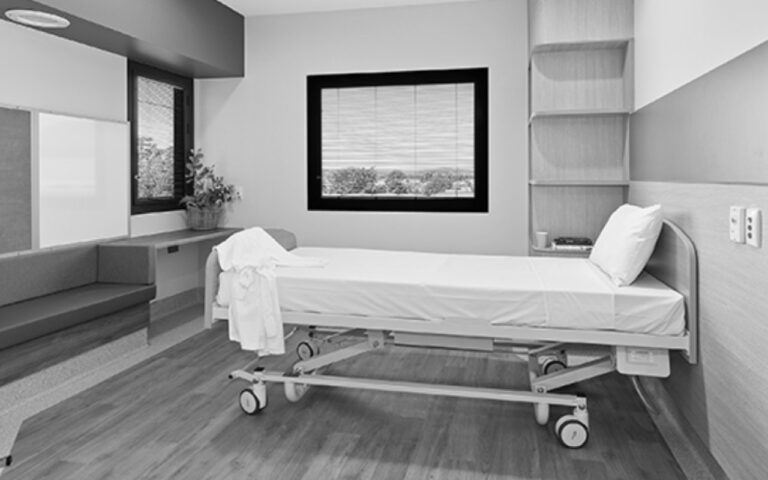
Header image: The Port Macquarie Base Hospital Mental Health Unit (AW Edwards).