Controversial laws used to ban the White Australia Party are necessary to protect minority groups from a “social crisis of unsuppressed racial hatred”, a government lawyer has claimed.
The White Australia Party (WAP) was listed as a prohibited hate group on May 15, under new laws brought in by both major parties in response to the Bondi Islamic terrorist attack, sparking a constitutional challenge by the party and Thomas Sewell.
The two-day hearing began on Tuesday in the High Court of Australia in Canberra, where the WAP’s barristers Peter King and Shahed Sharify, instructed by Paladin Lawyers, argued the hate group laws should be struck down.
Mr King and Mr Sharify argued that the laws impermissibly burdened the implied right to political communication guaranteed under the constitution, that the Commonwealth had exceeded its executive powers, and that the legislation breached the separation of powers.
The laws allow the government to ban organisations on the recommendation of the Director-General of Security, ASIO boss Mike Burgess, if the AFP minister decides they have committed loosely defined “hate crimes”, which do not require criminal convictions, and can be based on conduct that was legal at the time.
Leadership, membership, funding, training, and support then become illegal and punishable by up to 15 years’ jail.
Thomas Sewell speaks out about the White Australia Party’s constitutional challenge to the Labor government’s “hate group” laws after the end of day two of the hearing in Canberra.
“These laws are designed to destroy Australia”
Follow: @NoticerNews pic.twitter.com/SMMugyiPbS
— N News (@NoticerNews) September 9, 2026
On Wednesday, after Mr Sewell and associates echoed “God save the King” when it was said by the court clerk while opening proceedings, Commonwealth barrister Brendan Lim conceded that while the laws burdened the implied right to political communication, they would “enhance” Australia’s system of representative democracy by protecting minority groups from fear and harm.
Mr Lim told the court the laws were the only way to stop the White Australia Party, formerly known as the National Socialist Network (NSN), from potentially inspiring “political or communal violence”, because existing “hate speech” and Nazi symbols laws had been “ineffective”, as the group had not violated those laws.
He also argued that the White Australia Party’s end goal was to create a “national socialist country that would adopt a national socialist ideology”, and therefore should not be able to participate in politics.
When Chief Justice Stephen Gageler asked “is that in itself a problem? Could that create a risk?” Mr Lim replied: “Yes, national socialism is Nazi, that’s the risk.”
Mr Lim told the court that “words are violence”, and said that any burden on the political communication of the White Australia Party and its members was outweighed by the benefits to members of minority groups, and “positively advance” the implied right.
“Hate groups have a special impact on particular minority groups, and exclude victims of racist hate speech from public life,” Mr Lim said.
“There is a rich factual picture of that disturbing fact. A survey of Jewish women shows how anti-Semitism that falls short of hate crimes leads to social exclusion and self-censorship.”

Mr Lim also told the court that the ban was necessary because groups like the White Australia Party posed a threat “over and above the individuals that comprise them”, as their presence encourages hate crimes by members, “lone wolves” or people “inspired” by them.
“The NSN creates risk of inspiring attacks without issuing direct instructions, that’s why criminalisation of direct instruction is insufficient to meet the harm they pose. The magnitude of this risk should not be underestimated,” he said.
At one point he used the example of an NSN protest against Jewish lobby influence outside NSW Parliament on November 8 last year, and said the group’s use of the slogan “blood and honour” constituted a hate crime that justified the ban.
“It seems like a political protest but it is really a method of inciting racial hatred,” Mr Lim said, and when asked by Justice Jacqueline Gleeson what the slogan meant, replied that it was “used to spread terror among Jews”.
Justice Robert Beech-Jones asked whether the slogan had resulted in criminal prosecutions, and Mr Lim said there was no information before the court confirming that it had.
“The Minister’s finding is that the Nazi salute was criminalised, so they said ‘blood and honour instead’, it shows the lack of effective deterrence by laws targeting [specific offences],” Mr Lim said.
On Tuesday Mr Lim was asked by Justices Beech-Jones, James Edelman, and Michelle Gordon whether a group could reform without “race hate”, even if it was effectively the same organisation run by the same people.
He replied that this would not be possible in the case of the White Australia Party, confirmed the laws were written to allow the responsible minister to prevent groups from reforming, and said right-wing extremist groups “can’t be responded to with lesser legislation”.
Mr Lim told the court that the retrospective aspect of the laws – which allows conduct that was legal at the time to be ruled a hate crime – did not increase the “incremental burden”, as the legislation was designed to be “forward-looking” and the conduct was illegal in the future.
He also said the requirement that a prohibited hate group listing be made by the Director-General of Security was “significant because of the political neutrality” of the ASIO boss, saying it “shielded the legislation from partisan views” and that there was “limited political influence” over the spy agency.
Mr King told the court on Tuesday the laws were like “using a sledgehammer to crack a nut”, said the burden on political communication was “extreme”, and argued that a hate group listing denied members “free and open voice to participate in Australian democracy”.
He added that the laws were “not consistent with a system of representative government, where sometimes the causing of offence is necessary”, and that while the views of the WAP might be “distasteful to many”, that should be of no concern to the court.
Mr King, a former Liberal Party MP, also argued that although the laws were brought in as part of a legislative response to the Bondi massacre, they “do not address Bondi, and have not been used on the terrorist”, and cited a High Court ruling from 1951 overturning a ban of the Communist Party.
He told the court the legislation exceeded the government’s executive powers as they allowed a group to be banned based on the opinion of a single minister, following advice from the Director-General of Security.
He added that because a “hate crime” as defined in the laws was also determined by the judgement of the minister, rather than by the courts, that this meant the laws were based on a “double opinion”.
In response to the Commonwealth’s argument that the laws fulfill Australia’s obligations under United Nations treaties, Mr King said the legislation was not properly adapted, and “trashes rather than gives effect to the obligations”.
Mr Sharify argued that the laws burdened political communication, and focused his submissions on the “extraordinarily loose language” used in the definition of a “hate crime”, which he emphasised did not require criminal convictions, and applied to past legal conduct.
“A single instance [of non-criminal conduct] is enough, a single hate crime is sufficient to trigger the first aspect of the specification … it could be used against a party that on one occasion has done something the minister considers a hate crime,” he told the court.
“It cannot be the case that a few instances in the past can allow the party in power to ban its opposition.”
He told the court that the laws were too broad, lacked safeguards, and had no “sliding scale of punishment” as once a party was banned it was “gone forever”, and said the idea that the “mere presence of a party causes psychological harm … cannot work in a democracy”.
Mr Sharify went on to argue that the laws, which he described as “devious”, could be more narrowly tailored, should be reviewable, and could contain exemptions for forms of speech like fair comment, meaning that they were not proportional to their intended purpose.
“Why can’t you apply to the minister for delisting? You can apply to get delisted as a terrorism organisation, why do we not get that in [the hate group laws]?
“Groups can be reformed. The IRA can become Sinn Fein. The African National Congress can give up terrorism. None of this is factored in.”
The court is yet to rule on the case, and a decision could take weeks or months to be handed down.
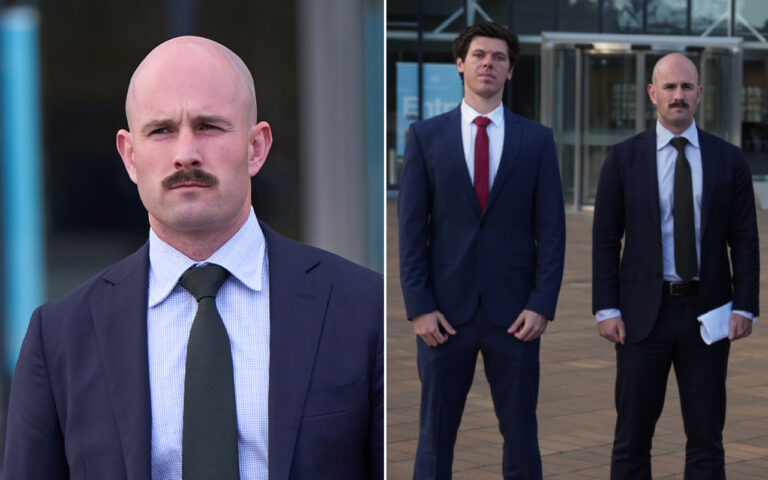
Header image: Left, Thomas Sewell outside the High Court on Wednesday. Right, Mr Sewell and Jack Eltis (beckonthedawn).