The White Australia Party has laid out its case against Labor’s prohibited hate group laws, arguing they “go too far” and allow the government to ban its political opposition based on the opinion of a single minister.
The laws, passed by both major parties after the Bondi Islamic terrorist attack, were used to ban the White Australia Party (WAP) on May 15, sparking legal action by the party and Thomas Sewell, which commenced in the High Court in Canberra on Tuesday.
Mr Sewell said outside court before the hearing began that the case was about stopping the government from banning rival political parties, and asked what right it had to tell people who they could vote for.
“Isn’t the whole point of democracy that the Australian public decides who forms government, not the government itself?” he asked.
“We believe that the White people in Australia should have the right to vote for a political party that does not wish for the ethnic replacement of White people.
“Australians should choose at the ballot box who they wish to represent them.”
Thomas Sewell speaks outside the High Court where he is challenging the banning of the White Australia Party on constitutional grounds.
The landmark case will determine whether the government has the power to outlaw political parties it disagrees with and criminalise its… pic.twitter.com/3xcFtKlExN
— N News (@NoticerNews) September 8, 2026
The WAP’s barristers Peter King and Shahed Sharify told the court the hate group laws impermissibly burdened the implied right to political communication guaranteed under the constitution, that the Commonwealth had exceeded its executive powers, and that the legislation breached the separation of powers.
Mr King told the court the laws were like “using a sledgehammer to crack a nut”, said the burden on political communication was “extreme”, and argued that a hate group listing denied members “free and open voice to participate in Australian democracy”.
He added that the laws were “not consistent with a system of representative government, where sometimes the causing of offence is necessary”, and that while the views of the WAP might be “distasteful to many”, that should be of no concern to the court.
Mr King, a former Liberal Party MP, also argued that although the laws were brought in as part of a legislative response to the Bondi massacre, they “do not address Bondi, and have not been used on the terrorist”, and cited a High Court ruling from 1951 overturning a ban of the Communist Party.
He told the court the legislation exceeded the government’s executive powers as they allowed a group to be banned based on the opinion of a single minister, following advice from the Director-General of Security.
He added that because a “hate crime” as defined in the laws was also determined by the judgement of the minister, rather than by the courts, that this meant the laws were based on a “double opinion”.
In response to the Commonwealth’s argument that the laws fulfill Australia’s obligations under United Nations treaties, Mr King said the legislation was not properly adapted, and “trashes rather than gives effect to the obligations”.
Mr Sharify argued that the laws burdened political communication, and focused his submissions on the “extraordinarily loose language” used in the definition of a “hate crime”, which he emphasised did not require criminal convictions, and applied to past legal conduct.
“A single instance [of non-criminal conduct] is enough, a single hate crime is sufficient to trigger the first aspect of the specification … it could be used against a party that on one occasion has done something the minister considers a hate crime,” he told the court.
“It cannot be the case that a few instances in the past can allow the party in power to ban its opposition.”
He told the court that the laws were too broad, lacked safeguards, and had no “sliding scale of punishment” as once a party was banned it was “gone forever”, and said the idea that the “mere presence of a party causes psychological harm … cannot work in a democracy”.
Mr Sharify went on to argue that the laws, which he described as “devious”, could be more narrowly tailored, should be reviewable, and could contain exemptions for forms of speech like fair comment, meaning that they were not proportional to their intended purpose.
“Why can’t you apply to the minister for delisting? You can apply to get delisted as a terrorism organisation, why do we not get that in [the hate group laws]?
“Groups can be reformed. The IRA can become Sinn Fein. The African National Congress can give up terrorism. None of this is factored in.”
Commonwealth barrister Brendan Lim was asked by Justices Robert Beech-Jones, James Edelman, and Michelle Gordon whether a group could reform without “race hate”, even if it was effectively the same organisation run by the same people.
Mr Lim replied that this would not be possible in the case of the White Australia Party, confirmed the laws were written to allow the responsible minister to prevent groups from reforming, and said right-wing extremist groups “can’t be responded to with lesser legislation”.
He conceded that the laws did burden political communication, but said the Commonwealth would argue that they did so in order to enhance the political communication of people who would be “harmed” by a prohibited hate group, making them constitutional.
Mr Lim told the court that the retrospective aspect of the laws – which allows conduct that was legal at the time to be ruled a hate crime – did not increase the “incremental burden”, as the legislation was designed to be “forward-looking” and the conduct was illegal in the future.
He also said the requirement that a prohibited hate group listing be made by the Director-General of Security was “significant because of the political neutrality” of the ASIO boss, saying it “shielded the legislation from partisan views” and that there was “limited political influence” over the spy agency.
The hearing continues on Wednesday.
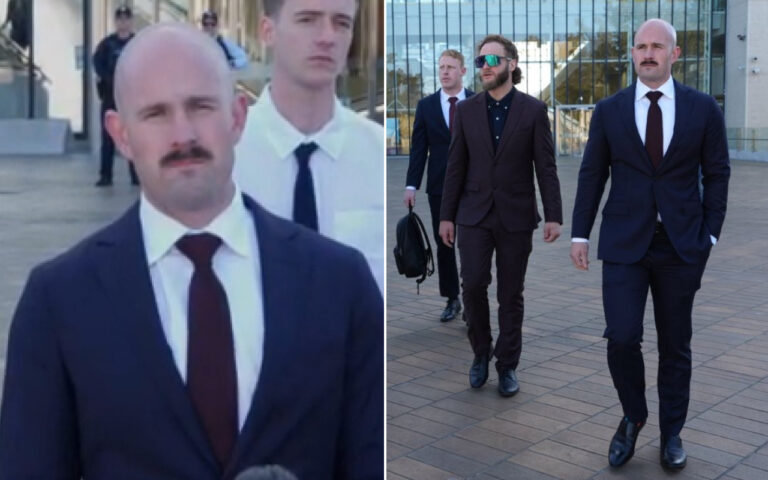
Header image: Left, right, Thomas Sewell outside the High Court on Tuesday (Supplied, Beckonthedawn).