Australia’s leading free speech advocacy group has applied to appear before the High Court during the White Australia Party’s challenge to Labor’s prohibited hate group laws.
The case is set to be heard on September 8 and 9, and is set to determine whether the government can ban rival political parties using controversial new laws passed by both major parties in response to the Bondi Islamic terrorist attack.
The White Australia Party (WAP) and Thomas Sewell launched legal action after it was listed as a prohibited hate group in May, on the grounds that the laws infringe on the implied freedom of political communication granted under the constitution, and permanently exclude former party members from political life.
The Free Speech Union of Australia (FSU) announced this week it was seeking to appear in proceedings as amicus curiae, which would allow it to make submissions defending constitutional rights without being a party to the case.
FSU Director Dr Reuben Kirkham said the implied freedom of political communication needed to protect all Australians, regardless of the popularity of their political views.
“What concerns us is the constitutional principle. Governments change. Political fashions change. The constitutional powers we create today won’t always be exercised by governments we agree with,” Dr Kirkham said.
“Despite the neo-Nazis’ best efforts to make this all about them, the real issue is our democracy. If today’s government can prohibit one political organisation with relatively little constitutional scrutiny, what prevents tomorrow’s government banning One Nation? Or an environmental activist group? Or a militant union? Or another organisation whose views have fallen out of favour?
“Constitutional protections exist precisely because governments cannot always be trusted to exercise power wisely. The Constitution belongs equally to Australians of every political persuasion.
“If the goal is to fight neo-Nazis, then this is the wrong approach. All this does is support their cause and give them a lot more attention than they would have otherwise received.”
The FSU said the case also presented an opportunity for the High Court to expand political freedoms, and said its proposed submissions would invite the Court to recognise that the greater the burden on political communication, the greater the justification government should be required to demonstrate.
“The constitutional principles established in this case will not be confined to the White Australia Party,” Dr Kirkham said.
“Whatever the outcome of these proceedings, the legal rules developed by the High Court will apply equally to every future government and every future political movement.
“This case is about ensuring that constitutional protections remain strong enough to safeguard democratic participation for all Australians – not just those whose views happen to be popular. At the minute they are doing it to Nazis, but the next censored views might be yours instead.”
The FSU is asking for public support on its website, where it calls the prohibited hate group laws an “undemocratic power grab” and warns that if the WAP case fails it will have a “chilling effect on all organisations, regardless of political persuasion”.
The hate group laws make it a criminal offence to direct, be a member of, recruit for, train, fund or support the WAP, punishable by up to 15 years’ imprisonment.
Legal experts and civil liberties advocates have warned the laws “abolish liberal democracy” and can be used to ban any political party, and the legislation has sparked calls for a constitutional bill of rights.
The FSU also expressed its opposition to the laws in a public submission to a parliamentary committee last month, saying they set a “dangerous precedent”, and allowed the government to “decide, in private and on secret advice, which political associations citizens may join, fund and vote for”.
A GiveSendGo set up by Mr Sewell to fund the legal action has raised almost $200,000 so far, and states that the challenge “seeks to protect the right of all Australians to politically communicate and organise, now and for those generations to come”.
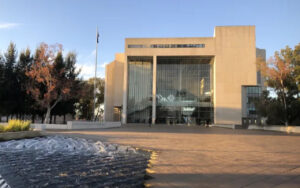
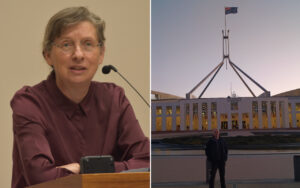
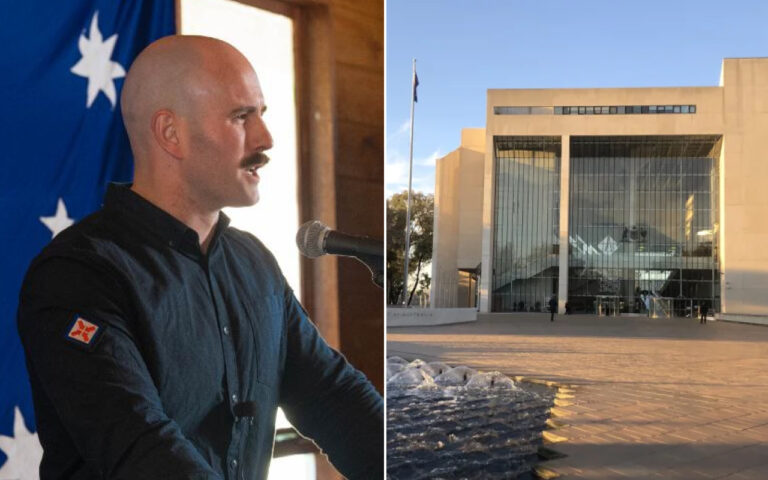
Header image: Left, Thomas Sewell (supplied). Right, the High Court of Australia in Canberra (HCA).