Adrian Beaumont, The University of Melbourne
With the Victorian state election in late November, two polls have Labor sinking to third on primary votes, behind One Nation and the Coalition. Labor Premier Jacinta Allan’s net approval is below -35 in both polls.
A federal Resolve poll agrees with other polls in having One Nation leading on primary votes. A three-way preferred PM question has Pauline Hanson leading.
Preference flows from the May 9 Farrer byelection have been released. A large portion of Liberal and National voters bucked the how to vote cards that had One Nation preferred over independent Michelle Milthorpe.
Labor in third in two Victorian polls
The Victorian state election is in late November. A Freshwater poll, conducted June 5–8 from a sample of 1,034, gave the Coalition 27% of the primary vote (down three since the late March Freshwater poll), One Nation 25% (up five), Labor 23% (down four), the Greens 14% (steady) and all Others 11% (up two).
Although Labor is third on primary votes, they would easily pass One Nation and the Coalition on Greens preferences. The Coalition led Labor by 53–47 after preferences, a one-point gain for the Coalition.
Allan’s net approval dropped five points to a dire -37. Liberal leader Jess Wilson was down three points to +15. Wilson led Allan as preferred premier by a blowout 49–25 (47–31 previously). On Allan, 62% (up four) wanted her replaced as Labor leader, with Labor voters opposed by 53–39.
A Victorian DemosAU and Premier National poll, conducted June 7–11 from a sample of 1,056, gave the Coalition 30% of the primary vote (up one since the February DemosAU poll), One Nation 23% (up two), Labor 21% (down two), the Greens 15% (steady) and all Others 11% (down one). The Coalition led Labor by 55–45 after preferences, a two-point gain for the Coalition.
Allan’s net positive score dropped two points to -39, with 57% rating her negatively and 18% positively. Wilson’s net positive score improved seven points to +10 (32% positive, 22% negative).
By the election, Labor will have governed Victoria for 12 consecutive years and 23 of the last 27, so it’s likely there’s an “it’s time” factor. I believe the polls are more likely to get worse for Labor than improve as the election approaches, especially given Allan’s dire ratings.
After federal Labor’s landslide in May 2025, Victorian Labor surged back to a lead according to The Poll Bludger’s BludgerTrack. But federal Labor isn’t popular anymore, and this hurts state Labor.
After Labor’s massive victory at the March 2021 Western Australian election gave them a majority in the upper house, they abolished group voting tickets among other reforms to the upper house electoral system. This left Victoria as the only Australian jurisdiction that still uses this discredited system.
Victorian Labor has been derelict in not supporting legislation to abolish group voting tickets in its 12 years in power. Unless that changes soon, this election will again use a system where parties direct preferences for the upper house, not voters.
Federal Resolve poll has Hanson leading as preferred PM
A national Resolve poll for Nine newspapers, conducted June 8–13 from a sample of 1,801, gave One Nation 29% of the primary vote (up five since the mid-May post-budget Resolve poll), Labor 28% (down one), the Coalition 20% (down three), the Greens 12% (steady), independents 7% (steady) and others 5% (steady). No two-party estimate was given.
In a three-way preferred PM question, Hanson had 33%, Anthony Albanese 29% and Angus Taylor 16%. In the conventional two-way question, Taylor led Albanese by 32–31 (33–30 previously). Resolve’s preferred PM polls have been worse for Albanese than others.
Albanese’s net approval improved two points to -20, with 55% giving him a bad rating and 35% a good rating. Taylor’s net approval dropped two points to +6 (38% good, 32% bad).
Support for key budget measures has slumped since May. By 34–29, respondents opposed the changes to family trusts (34–23 support previously). Respondents were split 31–31 on the changes to capital gains tax (36–21 support). The changes to negative gearing were still supported by 33–26 (35–21 previously).
Keeping the cost of living low was the top issue for 47% of respondents (up three), with no other issue in the double digits. Labor led the Liberals by 24–20 on this issue with 31% for “someone else” (27–24 to the Liberals in May). On economic management, the Liberals led Labor by 26–25 (33–23 in May).
Morgan poll: One Nation’s surge continues
A national Morgan poll, conducted June 1–7 from a sample of 1,631, gave One Nation 29.5% of the primary vote (up 2.5 since the May 25–31 Morgan poll), Labor 26% (down one), the Coalition 17.5% (down 2.5), the Greens 15.5% (up two) and all Others 11.5% (down one).
By respondent preferences, Labor led One Nation by an unchanged 53.5–46.5. Labor led the Coalition by 56–44, a 0.5-point gain for Labor. By 2025 election preference flows, Labor led the Coalition by 54–46, a 0.5-point gain for Labor.
Morgan is the only poll that has shown a surge for the Greens since the budget. In other polls, the Greens are steady or down.
Farrer byelection preference flows
At the May 9 Farrer federal byelection, One Nation’s David Farley defeated Michelle Milthorpe by 57.6–42.4 (56.2–43.8 to the Liberals over Milthorpe at the 2025 election).
Primary votes were 39.5% One Nation (up 32.9%), 28.1% Milthorpe (up 8.1%), 12.4% Liberals (down 31.0%), 9.8% Nationals (new), 2.3% Legalise Cannabis (new), 2.3% Greens (down 2.6%) and 2.0% Shooters (down 1.5%). Labor didn’t contest after receiving 15.1% in 2025.
Preference flows show that One Nation won Liberal preferences by 59.0–41.0 against Milthorpe and Nationals preferences by 69.1–30.9. Milthorpe won Legalise Cannabis preferences by 63.0–37.0 and Greens preferences by 91.8–8.2. One Nation won Shooters preferences by 60.6–39.4.
The Liberals and Nationals both had One Nation ahead of Milthorpe on their how to vote cards, so this data shows that a large portion of Liberal and National voters bucked the card. However, extrapolating preference flows from an independent vs One Nation contest to a Labor vs One Nation contest may be dubious as Labor is the traditional enemy of the Liberals and Nationals.
In final results of the May 16 Queensland Stafford byelection, Labor defeated the Liberal National Party (LNP) by 51.4–48.6, a 4.0% swing to the LNP since the 2024 Queensland election. A recent Queensland DemosAU poll gave the LNP a 58–42 statewide lead, over 4% above their election result.
Adrian Beaumont, Election Analyst (Psephologist) at The Conversation; and Honorary Associate, School of Mathematics and Statistics, The University of Melbourne
This article is republished from The Conversation under a Creative Commons license. Read the original article.
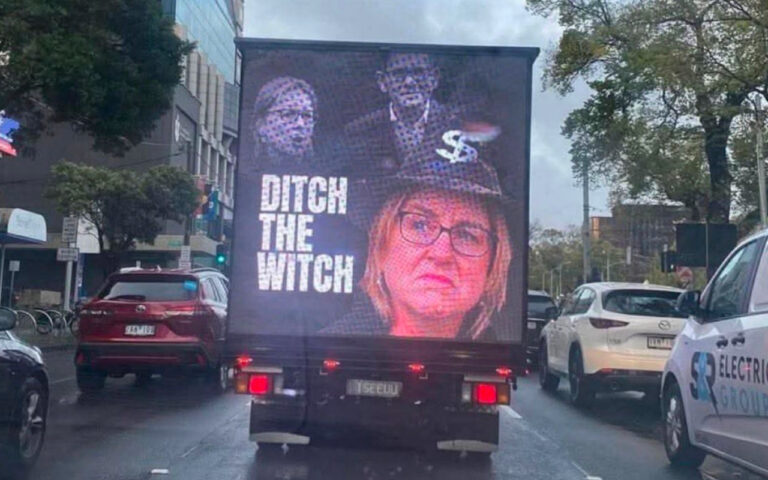
Header image: A mobile billboard campaign depicting Jacinta Allan as a witch (X).