One Nation has more primary support than Labor and is almost twice as popular as the Coalition, according to a major new poll conducted after the Federal Budget.
The Special Roy Morgan Snap SMS Poll, conducted from May 13 to 14 of a representative Australia-wide cross-section of 2,348 voters, also found a federal election held today with be “too close to call” on a two-party preferred basis between One Nation and Labor.
The poll had One Nation on 32% of the primary vote, followed by Labor on 28.5%, the Coalition on 16.5%, the Greens on 11.5% and all others on 11.5%, and came after Tuesday’s Budget which included broken promises on immigration levels and tax breaks, and gave billions to foreigners and minorities.
Labor was ahead of One Nation 51% to 45% two-party preferred, and had a clear lead over the Liberal and National Party Coalition, winning a head-to-head contest 55% to 45%. One Nation would also beat the Coalition 51% to 49%.
On a three-party preferred basis, Labor would end up on 44.5% of the vote, followed by One Nation on 44.5%, and the Coalition on 19%.
A majority of Australians, 59%, disapproved of the way Prime Minister Anthony Albanese is handling his job, while 40% approved and 1% could not say. A similar proportion, 57%, disapprove of the way Treasurer Jim Chalmers is doing his job.
The poll found One Nation voters are primarily motivated by concern about immigration and national identity, deep dissatisfaction with the major parties, perceptions that Australia is in economic and cultural decline, opposition to “woke” politics, climate policies and global institutions, belief that One Nation “puts Australians first”, and support for Pauline Hanson as an authentic and honest political figure.
Immigration reduction and “Australia first” was “by the the strongest and dominant theme” motivating One Nation voters, Roy Morgan found.
“Immigration was overwhelmingly the dominant issue. Respondents linked high migration to housing pressure, cost of living, cultural change, infrastructure strain and loss of national identity,” the poll noted.
“Many respondents emphasised sovereignty, patriotism, national identity and protecting ‘Australian values’ and culture.
“Respondents frequently connected economic hardship, housing affordability and rising costs to immigration, government spending and current economic policy.
“Many criticised “woke ideology”, identity politics, climate activism, gender politics and perceived political correctness.”
The poll found that a “significant subset of responses also contained explicitly anti-Muslim or anti-multicultural sentiments”.
Coalition voters, on the other hand, are primarily motivated by concerns about economic management and government debt, strong dissatisfaction with the Albanese Labor Government, belief that the Coalition is more fiscally responsible, support for lower immigration and more conservative policies, opposition to Labor’s budget, taxes and climate agenda, and perceptions that the Coalition is the only credible alternative government.”
“Compared with One Nation voters, Coalition voters were generally more focused on economic competence and governance, more institutional and pragmatic, less anti-system, and more concerned with fiscal management and stability than cultural disruption,” the poll stated.
“Immigration was a major issue, though generally expressed less aggressively than among One Nation voters.
“Unlike One Nation supporters, Coalition voters more often framed immigration as an economic and infrastructure issue rather than a cultural or identity issue.”
The poll also found that Labor voters are primarily motivated by alignment with progressive/social democratic values, perceptions that Labor governs for ordinary people rather than wealthy elites, trust in Labor’s economic management and stability, support for housing and tax reform, rejection of the Liberal Party and One Nation, and belief that Labor is the most competent and moderate governing option.
“Importantly, many voters appear motivated as much by opposition to the Liberals and One Nation as by enthusiasm for Labor itself,” Roy Morgan said.
“The strongest emotional drivers were fairness and equity, concern about inequality and housing affordability, fear of right-wing populism, and belief that Labor is more competent and moderate than alternatives.
“Some comments indicate support is conditional rather than unconditional, with several respondents describing Labor as simply the “best available option” rather than an ideal choice.”
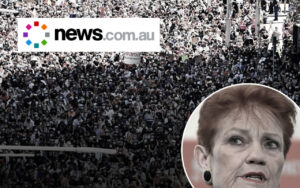
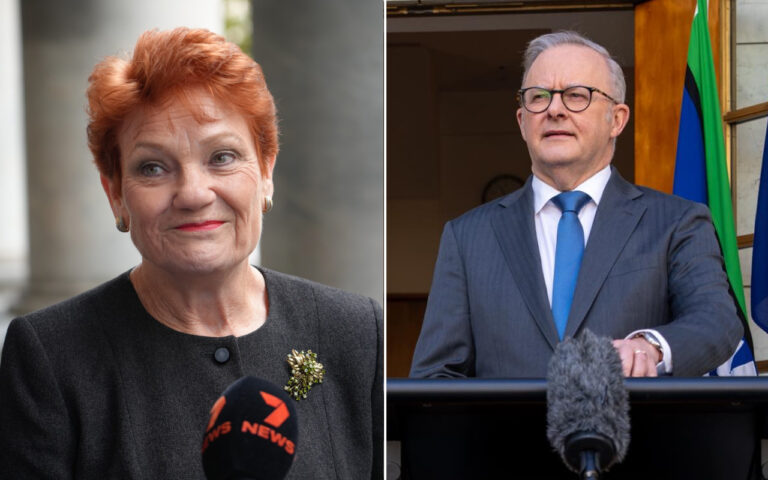
Header image: Right, Pauline Hanson. Left, Anthony Albanese (PMO).