Labor’s 2026 Federal Budget includes $68.5 million to provide HIV treatment or prevention medication to immigrants without access to the public health system.
The funding, to be delivered over three years from 2026-27, will “support elimination of HIV transmission in Australia by 2030 by providing HIV treatment and pre‑exposure prophylaxis (PrEP) to people who are not eligible for Medicare”, the Budget Measures state.
PrEP is medication taken by people who intend to have sex or inject illegal drugs with people with HIV or AIDS, and is used by between 20% and 35% of homosexual men, according to the Australasian Society for HIV, Viral Hepatitis and Sexual Health Medicine, and the Kirby Institute.
The Budget measure is included in $447.9 million worth of funding over five years, and $96.5 million per year ongoing, dedicated to reducing health risks through “preparedness and prevention measures”.
Also included is $379.4 million to “provide funding certainty for the National Medical Stockpile for pandemic preparedness and response to health emergencies”, within which is an Emergency Health Resilience Preparedness Fund to “respond to supply chain shocks or disruptions due to ongoing conflict in the Middle East”.
The Budget also provides $449.3 million over five years from 2025–26, and $60.9 million per year ongoing, to add pharmaceutical giant GlaxoSmithKline’s vaccine Arexvy vaccine for the mild Respiratory Syncytial Virus (RSV) to the National Immunisation Program.
The vaccine is available for Australians aged 75 and over, with aboriginal and Torres Strait Islander people given access from the age of 60.
According to a Medical Journal of Australia study of RSV hospitalisations from 2006 to 2015, there were just 138 in-hospital deaths from the illness during that period, of which 82 were in adults 65 and older – average of 8.2 per year.
The Australian Department of Health describes RSV as common and highly contagious, and notes that the main treatment for an RSV infection is rest and plenty of fluids.
RSV was not a nationally notifiable illness until 2021, and official cases went from seven in 2020 to 127,959 in 2023, with the vaccine then approved by the TGA in January 2024.
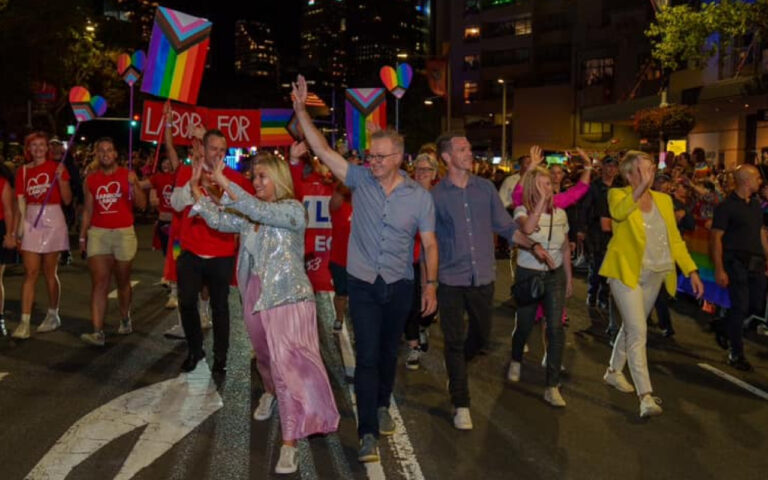
Header image: Prime Minister Anthony Albanese marches in the 2023 Mardi Gras with his wife Jodie, and NSW Premier Chris Minns (PMO).