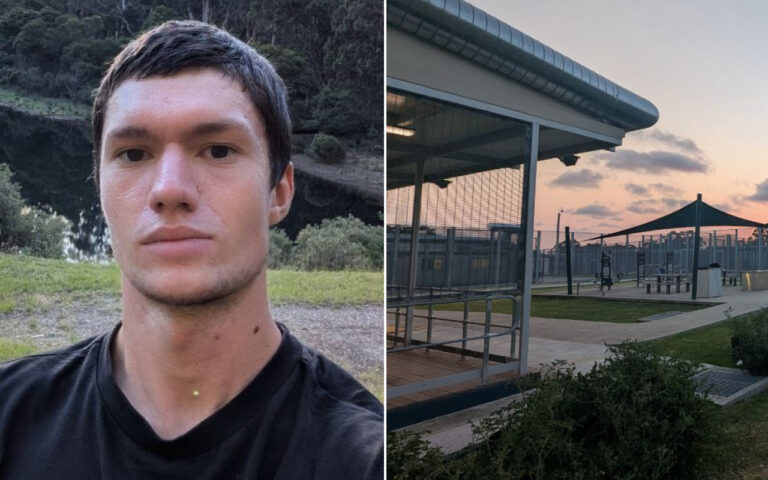
A Ukrainian refugee who is facing deportation for his political views has had an appeal personally rejected by a minister, meaning he cannot review the decision at a tribunal which regularly lets paedophiles and rapists stay in Australia.
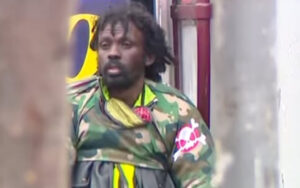
Yan Zakharin, 20, who came to Australia in 2022 after war broke out in his homeland, had his bridging visa cancelled on character grounds on December 24 last year and has been locked up in the Melbourne Immigration Detention Centre in Broadmeadows ever since.
He has no criminal convictions, but is among 15 members or associates of the now-disbanded National Socialist Network who were charged over an alleged clash with far-left extremists at aboriginal illegal squatter encampment “Camp Sovereignty” in Melbourne in August.
Mr Zakharin, who has pleaded not guilty to charges of affray, violent disorder and discharge missile, signed an agreement to be deported, only to be told by authorities he cannot be sent back to Ukraine because of the ongoing conflict with Russia, and he is now fighting to stay in Australia on a protection visa.
But on Thursday he was informed that his application to revoke the bridging visa cancellation was unsuccessful, and cannot be challenged at the Administrative Appeals Tribunal (ART) since the decision was made personally by Assistant Minister for Citizenship, Customs and Multicultural Affairs, Julian Hill.
According to documents seen by Noticer News, Mr Hill determined Mr Zakharin failed the character test due to his links to the NSN, alleged involvement in the “Camp Sovereignty” incident, and political ideology, and found his continued presence in Australia “would expose the community to the risk of further incitement of discord, and potential violence”.
In relation to the “Camp Sovereignty” charges, Mr Hill wrote: “I am aware that no convictions have been recorded in relation to these offences. For the purposes of the decision to cancel his visa on December 24 2025, and this consideration, I acknowledge that these pending charges are not findings of guilt. However, I also consider Victoria Police to be an authoritative source and that the charges have not been laid without basis.”
Mr Hill went on to describe the illegal squatter camp as a “sacred indigenous site” and a “sacred space dedicated to honouring indigenous ancestors and healing intergenerational trauma”.
“I am satisfied that Mr Zakharin’s involvement in the [alleged] violent attack on Camp Sovereignty, as well as his association with the NSN and his attendance at rallies, reflects a conscious commitment to promoting neo-Nazi ideology, race-based hate, and far-right activism in Australia,” he wrote.
“I consider such conduct materially advances the objectives of these far-right groups and demonstrates a willingness to participate in activities that undermine public order and social cohesion.”
He also noted that the NSN-linked White Australia Party has been listed as a prohibited hate group.
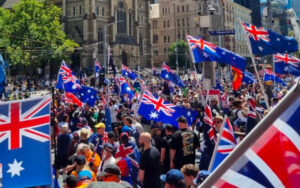
Mr Zakharin argued in his application that his attendance at the March for Australia before the “Camp Sovereignty” incident was motivated by political expression, that he was needed to care for his sick father, showed evidence of volunteer work at a Ukrainian church and is committed to living a responsible and positive life in Australia.
Mr Hill acknowledged Mr Zakharin’s “strong support network”, character references, and clean criminal history, but said the activist’s political views put the broader community at risk.
“I accept that Australia has a well-established tradition of free expression and this can include unpopular opinions, particularly when it comes to politics,” he wrote.
“However, where such opinions and conduct incite discord by stirring up harmful or deleterious or violent dissension or strife in the Australian community, I am cognisant that it puts the safety and wellbeing of the individuals targeted at significant risk of physical and/or psychological harm, as demonstrated in the [alleged] attack on Camp Sovereignty after the March for Australia rally.”
Mr Hill also said he was unable to consider Mr Zakharin’s risk of harm if returned to Ukraine, which he said would have to be determined during the processing of his ongoing protection visa application.
Mr Zakharin told Noticer News that while he is unable to review Mr Hill’s decision at the ART, he will fight for as long as he can to stay in the country, saying he believes his rights to freedom of speech, expression and political association are being trampled on.
Dozens of serious criminals have had their visa cancellations revoked by the ART this year so far, including a rapist Iraqi refugee drug smuggler, an African refugee paedophile, a Chinese wife-killer, an Ethiopian rapist, an obese homosexual Indian paedophile, an Iranian drug smuggler, a killer Sri Lankan driver, and a Sudanese refugee who killed an Aussie teenager.
But South African civil engineer Matthew Gruter also had his work visa personally cancelled by immigration minister Tony Burke in November last year after taking part in a peaceful and police-approved NSN protest, followed by British veteran Ryan Turner in January for giving NSN members boxing lessons.
Mr Gruter was deported within weeks along with his wife and newborn baby, while Mr Turner is fighting deportation from inside Western Australia’s Yongah Hill Immigration Detention Centre.
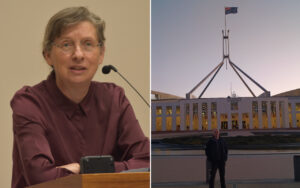
Header image: Left, Yan Zakharin. Right, the Melbourne Immigration Detention Centre (supplied).