Denmark’s centre-left government will ban Muslim burqas in schools and universities as part of ongoing efforts to prevent “parallel societies” of immigrants.
Full-face Islamic veils such as the burqa and niqab are already banned in public, but Social Democrats Prime Minister Mette Frederiksen said the law should also be applied to the country’s educational institutions.
“There are gaps in the legislation that allow Muslim social control and oppression of women at educational institutions in Denmark,” Ms Frederiksen told Danish media on Thursday.
“You have the right to be a person of faith and practice your religion, but democracy takes precedence.
“You are welcome to have your religion, but when you’re at school, you’re there to be at school and take part in your education.”
The Danish immigration ministry confirmed that the government was set to present a new bill “on strengthened efforts against parallel societies and negative social control”.
The proposal would expand Denmark’s 2018 burqa ban, which prohibits garments that conceal the face in public spaces and is punishable with fines of up to 10,000 kroners for repeat offenders.
Ms Frederiksen also wants prayer rooms removed from Denmark’s educational institutions, saying they “provide a breeding ground for discrimination and pressure”, but is not calling for an outright ban, Euronews reported.
The announcement comes less than a month after Danish immigration minister Morten Bødskov revealed the government would be seeking to ban the Muslim call to prayer due to concerns about creeping Islamisation.
Mr Bødskov said Islam was “taking up too much of the public space” and that the call to prayer, often made from loudspeakers on mosque minarets, “should not be heard over Danish rooftops”.
“It has no place in Denmark, and you shouldn’t be in any doubt whether you’ve ended up in a suburb of Islamabad when you walk around Denmark,” he said last month.
The left-leaning Social Democrats have introduced some of Europe’s toughest immigration laws due to public concern about integration and the tax burden of non-Western immigrants, and Denmark now has a lower proportion of foreign-born residents than neighbouring countries.
Denmark’s “parallel society” laws allow the government to reduce public housing in areas that have become more than 50% non-Western and suffer from socio-economic issues such as crime or unemployment.
Immigrant activists are attempting to have the laws, which were introduced in 2018, overturned in the courts on “racial discrimination” grounds.
The Netherlands, France, Belgium, Austria, and Switzerland have introduced nationwide or partial bans, while Norway has prohibited face coverings in educational institutions since 2018.
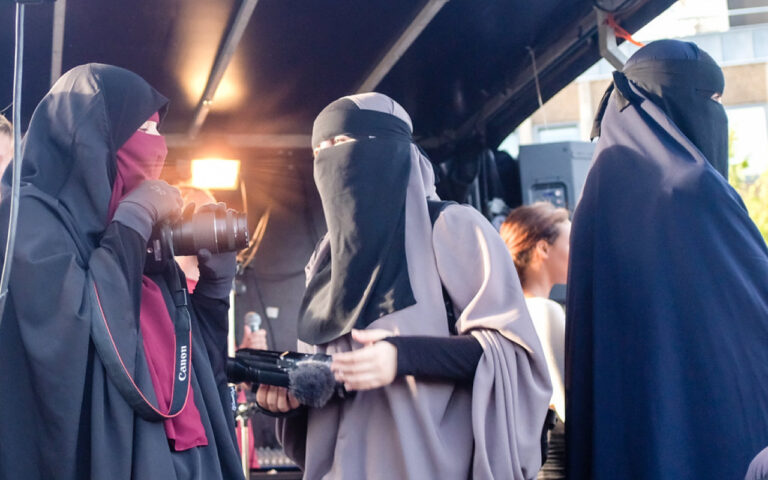
Header image: Protest against burka/niqab ban in Copenhagen (Klaus Berdiin Jensen, CC BY-NC-SA 2.0).