In order to make political change, it is necessary to understand the conditions under which political change is possible.
Because we have all been raised with the narrative of democracy and popular sovereignty, most Australians possess a kind of naïve voluntarism when it comes to politics. It is a bias that few are even aware of having.
In this kind of thinking, all that is needed to acquire political power is the right amount of willpower and organisational ability. If others have failed to make the desired political change in the past, it must be because they lacked the skills or temperament to create a political movement. Or maybe because they simply didn’t want it hard enough.
The question of whether historical conditions permit the sort of change desired is barely raised, as is the question of what Australia’s existing power structure really looks like, and how change could actually be enacted.
What are the historical conditions that we are living under, and what is the real power structure of Australia?
As I discussed in a previous article, Australia today is not a liberal democracy, but a managerial state.
Its legitimacy does not lie in the provision of political liberties and popular representation, but on endless social engineering and the expansion of the state ever further into the private sphere. Its power base is the ever-increasing masses of salaried bureaucrats, who derive their authority not from ownership of the means of production, but from their expertise in running the infinitely complex and interlocking systems needed to coordinate a developed high-tech economy and welfare state.
The social contract of managerialism is not the classical liberal slogan of “no taxation without representation”, but rather the utilitarian promise that applying technocratic expertise to all aspects of social and economic life will result in an egalitarian cosmopolitan utopia.
It demands the abolition or absorption of all intermediate levels of power between the state and the individual, in the name of liberating the individual from inequality and discrimination.
It promises not political debate, but the negation of politics, where power is transitioned from the governance of people to the management of things (ie. from political discourse between different social groups, to a unified technocratic management of economic matters).
Its orientation is international, seeking to bring ever-vaster numbers of people under its domain, and aiming to mirror domestic structures of governance in the international system through the formation of multilateral treaties, international parliaments, international courts and positive international law.
More important on a practical level is that Australia is a managerial state in transition from what Samuel T Francis called a soft managerial power to a hard one.
Soft managerialism relies on the education system, the media, think tanks, churches, political parties and NGOs (what Curtis Yarvin calls the Cathedral) in order to socialise the masses into its utopian worldview. It is easiest to control the masses if they aren’t even aware that they are being controlled, and believe that they are the ones influencing elites and not the other way around.
This was the type of system that dominated Australia from roughly 1945 up until the Covid pandemic. Everyone was onboard with a big multicultural Australia completely integrated into Asia, with an economy wide open to international trade and finance. If you weren’t, then you were simply banished from the Cathedral. In the days before the internet, this was akin to being completely censored. You could talk all you wanted, but if no newspaper, magazine or television station was willing to provide you with a platform then you had an audience of one.
Now that the internet has effectively bypassed the power of the Cathedral, and the system is running up against the limitations of its economic and social model, it is increasingly turning to hard managerialism.
Put simply, hard managerialism primarily relies on force instead of persuasion. It contains the classic repertoire of political repression that we are all familiar with from the Soviet Union – secret police forces, mass surveillance, government censorship, overt propaganda (“Diversity is our strength!”), and weaponisation of the legal system against political opponents. If the masses cannot be convinced of the need for sacrifice to reach the egalitarian cosmopolitan utopia, then they will have to be (in the words of Jean-Jacques Rousseau) “forced to be free”.
The pandemic was not the start of this process, but the moment during which the people in charge realised that not only could they use hard managerialist measures to impose unprecedented forms of social control, but that a large portion of the Australian population would actually cheer them on while they were doing it.
You could lock 90% of the population in their own homes for months at a time, but still get them to support the police when they fired rubber bullets into the crowds of people who weren’t okay with having their livelihoods destroyed and their basic liberties stolen for no obvious purpose. You could actually impose Soviet-style internal passports on the population for everyday activities like going to a cafe or seeing a film, and most Australians would comply.
From there it was only a short step to organising federal police raids on the homes of Australians for owning political books, and setting up teams of feds to trawl social media looking for excuses to lock people up for saying mean words about politicians.
Now that we have outlined the historical and power context in which politics is conducted in Australia, we must turn to the question of whether it is possible to enact meaningful political change within those parameters.
The majority of dissidents in Australia still believe that the country’s political power structure is like a car – just change the driver and you can take it wherever you want. Seize power, and a neutral and efficient public service will unthinkingly carry out whatever commands you want.
This is hardly a viewpoint unique to them. Mass democracy always channels critiques of the system into the model of a loyal opposition – the mental habit of meeting every perceived failure of the state with a rejoinder of “what I would do if I was in power”. As Bertrand de Jouvenel pointed out in his classic On Power, mass democracy not only mentally blurs the line between rulers and ruled, but also creates a desire among would-be revolutionaries to avoid attacking the machinery of state. Everyone is a potential future leader, and thus the state is seen as the potential patrimony of all. To mangle the old quote about Americans, in a mass democracy everybody believes himself to be a temporarily inconvenienced Prime Minister.
Unfortunately, recent events have shown that this is assuredly not the case. As I discussed in a previous article, the Australian regime does not even pretend to be neutral. It does not try to demonstrate that there is any meaningful separation of powers, whether within government or outside of it. It uses the concept of “human rights” only where it is useful in expanding bureaucratic power, and never when it could be used to oppose the state’s social engineering.
When Tony Burke and Chris Minns tell you that freedom of speech needs to be sacrificed to protect the “social cohesion” of “modern Australia”, you should believe them. When the federal government passes laws that allow it to ban political organisations for no reason other than the Home Affairs Minister and the head of ASIO disliking them, it is not an aberration, but merely the latest stop on a much wider process of social control.
You cannot appeal to the fairness of a system that views you as a Schmittian enemy posing an existential danger to its utopian project. You will never get to hold power under the existing system, because it will never let you. At best you will get a Golden Dawn-style rug-pull, where the state feigns neutrality right up until the moment it retroactively declares your party a criminal organisation and throws its top members into prison en masse. Believing that political change can be enacted via democracy under managerialism is akin to going to the casino and expecting to become a millionaire – the house always wins.
It is a pointless waste of time and energy attempting to reform such a system, or to pressure it into adopting policies that contradict its utopian ideology.
Thankfully we live during a moment when the relentless centralisation of power, which has been an ongoing process since the end of the Middle Ages, appears to finally be reversing.
The implementation of hard managerialist measures to quash dissent is a sign of weakness and not strength. Sovereignty is gradually slipping out of the hands of the managerialist elite in myriad different ways. Their dream of a world state has been permanently smashed on the battlefields of Ukraine and on the Strait of Hormuz.
At home, multiculturalism and mass immigration have destroyed the social trust and homogeneity necessary to maintain a functional polity. Groups that have retained their tribal loyalties and folk culture, from the Afghans to Arab and Pacific Islander cigarette smugglers, have proven to be surprisingly resistant to even the most coercive techniques of managerialist control.
At a time when the managerialist system has become almost completely closed to outside influence, the power of that system is gradually shrinking. The possibility of exit from the system, and the development of new forms of localised sovereignty, has never looked more attainable.
We may not be able to change the old system, but a new one is emerging more and more every day. Much that was once considered settled will soon be up for grabs.
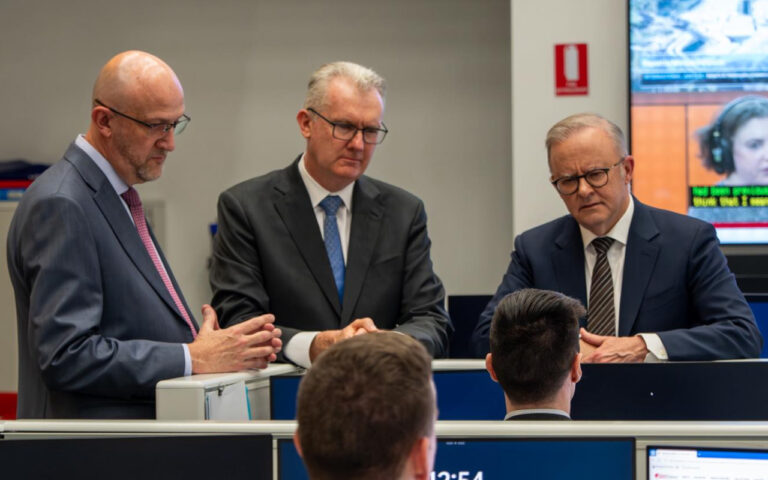
Header image: ASIO boss Mike Burgess, Home Affairs Minister Tony Burke, and Prime Minister Anthony Albanese after the Bondi Islamic terrorist attack (PMO).