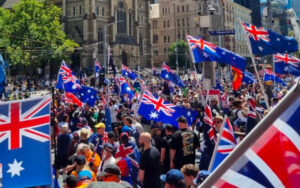
On 30 August, Australians will march for a future where they can express themselves without fear of legal repercussions for political speech.
Some are questioning the decision to march, asking: “Why bother? It will be hijacked, it will be cringe, it is over.”
The simplest answer is this – the political class wants to end the right wing as an oppositional force permanently, and if we don’t resist, that’s where this is heading.
First, we must understand that the Labor government and the political class aim to silence opposition to their long-term plans. Labor has obviously decided to hand over more power to the security services. Persuasion and bribery have failed to sway the public into accepting their multicultural agenda without argument, so they must rely on force. This is pernicious enough, yet there is a deeper issue, which is that the ABS found that, when asked whether the police could be trusted, only 69.2% of Australians agreed.
Labor is banking on these institutions to exploit the public’s goodwill toward the few arms of the state they still trust. The goal is to create a state of emergency, where the public will accept extraordinary government action to end free speech, a fundamental right in a supposed liberal democracy. The security services are key to this, as both parliament and politicians lack the moral authority to take us where Labor wants to go.
AFP Commissioner Krissy Barrett and ASIO Director-General Mike Burgess are doing the most crucial work for Labor in ending freedom of speech in Australia, and the irony is they are doing it with the very freedom of speech they themselves have been given. Their constant media appearances, unseen in any previous decade, frame patriots, anti-authority sympathisers, and nationalist advocates as an existential threat to Australian “social cohesion” and the continuation of the “most successful multicultural society”.
Through these security actors, who are highly trusted by a politically apathetic general public compared to many institutions connected to the state, Labor hopes to turn freedom of speech from a politicised issue into a securitised one, where ordinary democratic contestation becomes increasingly subordinate to security decision-making.
This is why it matters to understand what happens when an issue moves from the political sphere into the security sphere, where democratic debate no longer applies.
The historical norm in Australia is that freedom of speech is a politicised issue, debated and defined through democratic means by elected officials who promise voters to protect it but often fail to do so, risking their seats.
Securitising freedom of speech means prohibiting elements the government disapproves of, and framing them as a threat to social cohesion. People have no clear way to reverse this. Instead, they face extraordinary measures, surveillance, and restrictions justified by urgency, which makes them impossible to challenge.
The freedom of speech march on August 30 is a way to push back against this framing and show that freedom of speech is fundamental to the Australian way of life.
The march acts as a way to claw back freedom of speech as a politicised idea, keeping it from securitisation. If freedom of speech is successfully securitised, it will be the security services that decide to what extent we are allowed to exercise it, instead of the people.
And with the new powers Labor is pushing to give ASIO, adult questioning warrants are being expanded to include promoting “communal violence” as a reason to obtain a warrant on an individual, allowing for coercive compulsory questioning. If you fail to answer any question they ask, it is jail. If you tell anyone about the experience, it is jail. This applies to anyone, including teenagers over the age of 14, who could be brought in under these laws.
This creates an environment in which Australian patriots are becoming Homo Sacer.
The concept of Homo Sacer originated in Rome as a legal status that carried no legal protections or political rights. The lives of persons with this status were considered so worthless that the gods would not accept them as sacrifice, and anyone could murder them with impunity.
Giorgio Agamben revived this concept to explain how democratic states can strip certain people of their rights. He calls this the State of Exception, where the state suspends normal rules for particular groups. The Sovereign, as defined by Carl Schmitt, is the one who decides the exception.
The modern Homo Sacer remains subject to Sovereign power while being excluded from ordinary political and legal protection – what Agamben presents as a form of inclusion through exclusion, suspended by the Sovereign’s absolute right. The modern Homo Sacer is completely subject to the legal order, but excluded from it as it lacks any rights to participate in or affect the system.
Creating a modern Homo Sacer means producing a life with so little value that the government need not worry about its opinion or suffering. Yet they draw the Sovereign’s eye, who exercises the absolute right to leave them exposed and unprotected, unlike regular citizens.
This is where the Australian patriot ends up, as vulnerable as the ancient Roman Homo Sacer, reduced to what Agamben calls “bare life”: biological existence stripped of secure political status.
Labor has already begun this process with the “Combatting Antisemitism, Hate and Extremism (Criminal and Migration Laws) Act 2026“, which effectively criminalises organising around a White political identity or advocating for previous immigration laws.
The elite aim to take us there. It is now illegal to knowingly continue as a “member”, or an “informal member” of a designated organisation, punishable with a seven-year sentence. Directing, training, or funding these organisations can carry a 15-year jail sentence.
If an organisation does not disband before the Home Affairs Minister prohibits it as a “hate group”, freedom of association is irrelevant; any interaction between those who were in the now designated “hate groups” and their continued relationships could potentially be used as evidence of continuing informal membership.
In a democracy, it is fundamental the people are able to express their political freedoms and interests effectively; one must be able to organise people into groups, using numbers to press an issue and enact change of any kind. Banning or severely restricting the collective organisation of Australian patriots over their collective political identity ends their life in a democratic system.
Labor has already shown itself happy to treat Australian patriots as Homo Sacer, as seen in the case of Matthew Gruter. He was on a work visa, which matters legally in how severely they could treat him. Through Agamben’s lens, we can view his visa status as that of a vulnerable member of the nation’s body politic whose access to the nation’s body politic was easier to end, making him a softer target with which to begin this process. But that does not change the fact that the political elite viewed Gruter as Homo Sacer; in their view, he’s no different from a born-and-bred Australian patriot. Both are just Homo Sacer to them, an entity with no right or say.
Gruter’s grand crime – that the Sovereign found the need to take extraordinary steps to deport him and his family back to South Africa, a land where any manner of violent acts can be done upon him with no real avenue of recourse, leaving him completely vulnerable and stripped of rights – was going to a political protest in a democracy, which had received police approval.
However, the political elite simply saw it as the crime of being Homo Sacer; for that, the Sovereign put him in a situation where harm could easily befall him and his family, which can only be interpreted as the Sovereign expressing its ultimate right, the right to decide whose lives are valued and shielded from harm, and whose are not.
If Labor could create a State of Exception where the public would accept doing this to citizens, they would. This is made evident by how they endanger patriots by leaving them without a voice to defend their identity, allowing for other groups to effectively target them and advocate against them, since effective counter-political action is now easily outlawed.
This is where we are going: Homo Sacer in our own country, made into future exiles without rights by a Sovereign that is already sick of our existence.
The August 30 march, therefore, is vital. If those on the right do not unite to advocate for freedom of speech as a needed constitutional right, then, regardless of your political identity, you risk being rendered powerless and voiceless by those in authority.
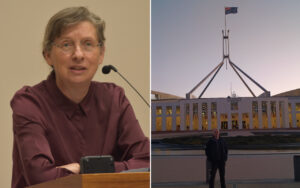
Henry Seward is a security patriot who simply wishes to speak the truth in a world that doesn’t operate on it.
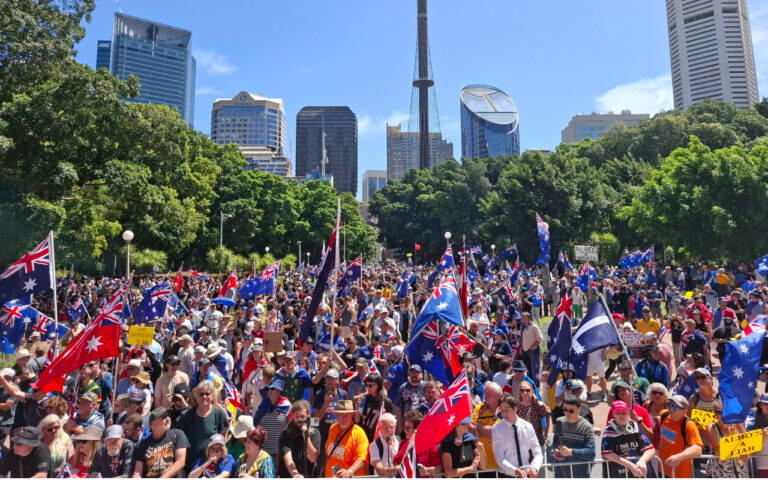
Header image: A March for Australia protest last year (Jesse Stewart – X)