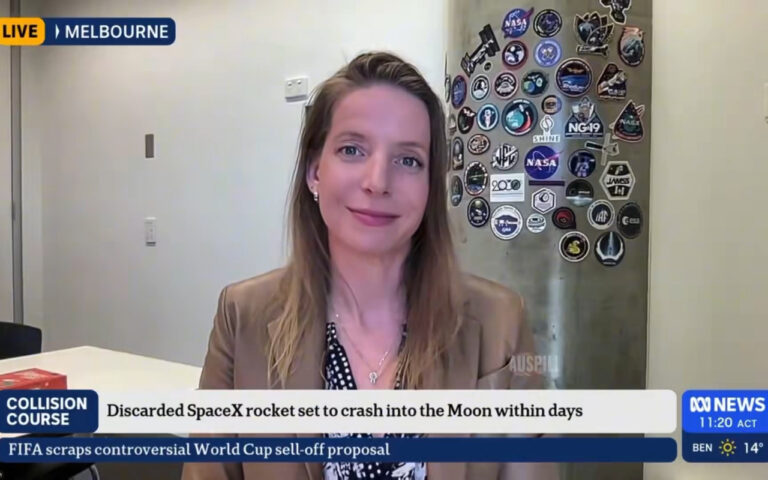
An astronomer has claimed the moon is part of “indigenous sky country” after being asked whether Australians should have any concerns about a SpaceX rocket which is set to crash into the lunar surface this week.
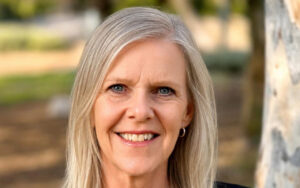
Rebecca Allen, the Co-Director of the Space Technology and Industry Institute at Swinburne University of Technology in Melbourne, also said the moon was important for aboriginal storytelling, and therefore “not just something for us to go and explore”.
Dr Allen made the comments during an ABC News segment about the SpaceX rocket, which is predicted to collide with the moon on Wednesday while travelling at 8,700km/h, and leave a crater 27 metres across and five metres deep.
An astronomer’s response to whether we should be concerned about SpaceX debris hitting the moon is a rant about “indigenous sky country” pic.twitter.com/4sUpOpc0eh
— auspill (@aus_pill) August 1, 2026
“Is this impact something we should be concerned about, or is the concern more about space junk just continuously piling up around the orbit of Earth?” Dr Allen was asked.
“The moon is something that has fascinated us and is deeply rooted to indigenous sky country and storytelling, and so we want to respect the fact that this is not just something for us to go and explore, as amazing as that is,” the astronomer responded.
“So I think it’s actually a big focus for global space regulation as well as understanding Australia’s growing role in space exploration and how we continue to be responsible, while pushing the boundaries and enabling new economic opportunities, innovation and inspiration.
“But we’ve got to be doing it in the right way, so this is a huge topic of conversation now for us globally.”
Late last year The University of Newcastle was given more than $500,000 in taxpayer funding to “embed aboriginal and Torres Strait Islander knowledge in Australian space policy’’ via a project that also used the term “sky country”.
The university said the $528,491 Australian Research Council grant will “help shape culturally respectful and environmentally responsible space exploration”.
“Learning from songlines, creation stories and deep cultural connections between people and sky country, the research will develop intercultural guidelines to help inform space policy, public education and industry practice,” the university said.
“The project aims to broaden Australia’s understanding of space by recognising long-held Indigenous knowledge systems and their relevance to sustainable human activity beyond Earth.”
Last year a senior bureaucrat with the Office of the eSafety Commissioner, Australia’s online censorship chief, also sparked criticism for starting a podcast interview with an aboriginal airwaves acknowledgment.
“Before we begin, we would like to acknowledge the traditional custodians of the lands and airways on which we are meeting and broadcasting today,” Toby Dagg said.
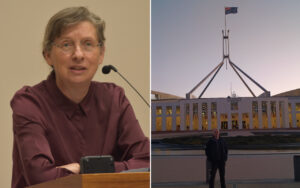
Header image: Dr Allen during the interview (ABC News).