The Australian Federal Police Commissioner has included “social cohesion” in her top five priorities, while counter-terrorism does not rate a mention despite the AFP’s failure to stop the Bondi Islamic terrorist attack.
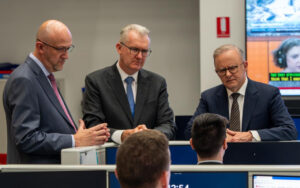
Commissioner Krissy Barrett, who has been criticised for arresting Aussies for social media posts while the ISIS-inspired Bondi shooters were planning their massacre undetected, presented the AFP’s Corporate Plan 2026-27 on Monday.
In a foreword, Ms Barrett laid out her five “enterprise priorities” – “futureproofing our workforce”, “supercharging global operations”, “defending Australia’s domestic security and our region”, “protecting vulnerable communities, prioritising social cohesion”, and “investing in science and technology-led capability”.
“Australia continues to face emerging challenges driven by converging crime types, expanding criminal motivations, threats to social cohesion, and increased targeting of vulnerable communities,” she said.
The Corporate Plan emphasises the need for a “diverse” workforce, and states that the AFP’s “operating context themes” are “global shifts and global dynamics”, “social cohesion and extremism”, “vulnerable communities”, “technology and criminal innovation”, “convergent crime ecosystems”.
“We prevent and disrupt threats and crime actors which seek to harm or radicalise vulnerable communities. We prioritise safety and social cohesion, and are agile in responding to those seeking to damage our social fabric and create hatred, division and harm,” the vulnerable communities section states.
The Plan does not mention terrorism until a section on “operating environment”, which states that the AFP needs “ongoing effort” to maintain community trust and confidence “in the face of rapidly changing social norms and those who seek to undermine social cohesion through promoting hostility and radicalisation”.
“The convergence of terrorism, foreign interference, hate crime, cybercrime and disinformation creates a complex threat environment. In environments characterised by mistrust and social division, foreign governments and their proxies may seek to exploit tensions to advance strategic narratives and undermine confidence in institutions and democratic processes,” the Plan states.
“Availability of extremist material online remains a challenge, supporting activity by lone actors and small groups. Rising anti-Semitism, Islamophobia and politically motivated violence, amplified by global conflicts and domestic polarisation, further threaten vulnerable communities and democratic institutions.
“We also remain committed to monitoring and targeting extremism and threats to social cohesion in Australia, including through ensuring our workforce comprises people with diverse skill sets and backgrounds. In 2026–27, we will begin to stand up a forward-leaning response to the evolving threat of online violent extremism and terrorism.”
In August the AFP revealed it was spending less than 10% of its budget on counter-terrorism, and almost four times more protecting politicians and government buildings.
Last year Prime Minister Anthony Albanese complained about the “high temperature” of social media comments, and Ms Barrett in October established National Security Investigations (NSI) teams to prevent “harm to social cohesion”, which she has dubbed her “flying squad of hate disruptors”.
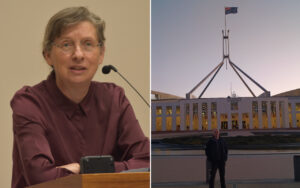
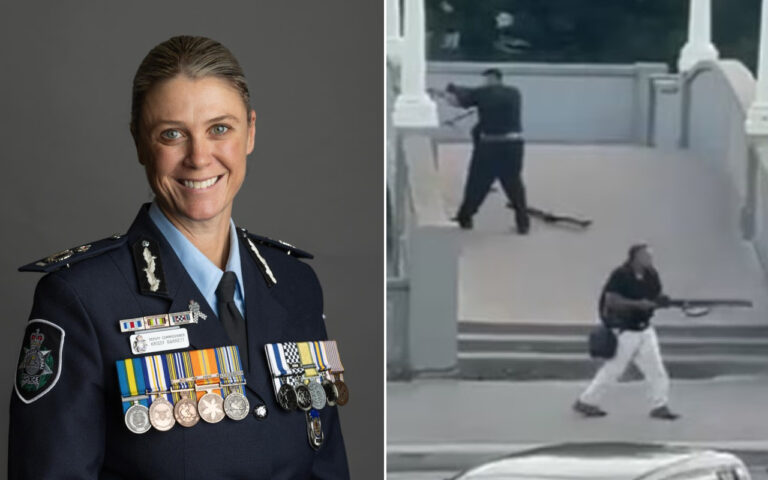
Header image: Left, Krissy Barrett (AFP). Right, the Bondi terrorists (X).