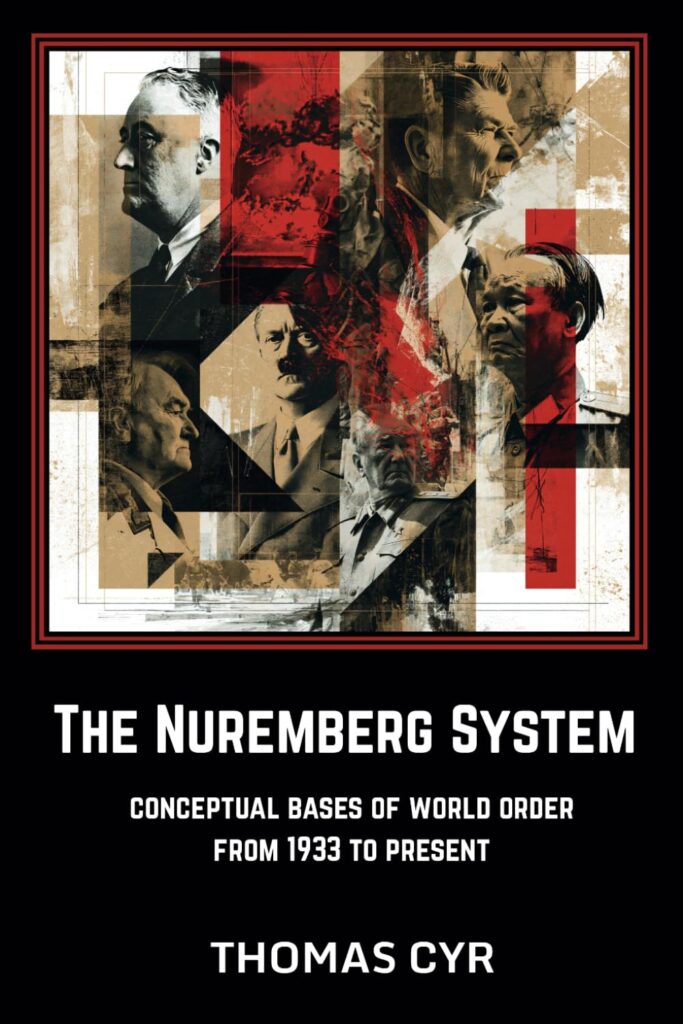
There are few thinkers on the dissident right who have anything genuinely interesting to say. There are even fewer within that group who aren’t being paid by Peter Thiel, Zionist interests or the US State Department (or sometimes even all of the above at the same time). One of the most prominent voices in the latter minority is independent American political philosopher and historian Thomas Cyr, better known online as Thomas777. In August Cyr released his first published work of non-fiction, The Nuremberg System: Conceptual Bases Of World Order From 1933 To Present.
It is a startlingly original work of historical revisionism that deserves a wide audience. The majority of revisionists focus on the details of history – the interpretation documents, the uncovering of new primary sources, or the combination of historical facts into new configurations which contradict previously held historical narratives. One could include such examples as AJP Taylor’s The Origins of the Second World War, or Viktor Suvorov’s Icebreaker. In The Nuremberg System Cyr goes much further, synthesising decades of historical revisionist and mainstream research into an original hypothesis about the origins of the hostile political and ideological order that European peoples across the world have inherited.
Historical revisionism and why it matters
Before beginning the review, we must first understand what historical revisionism is and what it is not. Historical revisionism is not simply an inversion of the regime’s morality play version of history, where Hitler becomes an unimpeachable hero, and the Allies irredeemable villains. Nor does it have anything to do with trying to rehabilitate the reputation of the Third Reich in order to somehow revive it in the present day.
Instead, the aim of true historical revisionism is to examine the founding myths of the American regime and its Communist allies, and then demythologise them. World War II and the Holocaust are not normal history, but are laden with implicit value judgements and ideological commands. They are the foundation of the legitimacy of the current world order, and as such are accorded the reverence previously reserved for Christianity during the age of the divine right of kings. Historical revisionism takes those myths and subjects them to an act of radical deconstruction, where the real historical events are rescued from the ideological tableaux in which they have been placed by the regime’s propagandists and court historians.
Stripped of the regime’s ideological narratives, World War II and the Holocaust become historical events, just like any other. They lose their power of political mobilisation and legitimation. Critics will argue that this deconstruction is done with political intent, and they are correct. By destroying the dead hand of pseudo-history, new types of politics become possible in the present. The West will only become a normal historical actor again when it can leave behind the collective nightmare that European civilisation entered on the commencement of the Great War in 1914, and from which it has yet to awaken.
The victor’s narrative about World War II is most definitely not an academic point of debate, but continues to guide and justify the actions of all the victorious powers up until the present day. Europeans are still an occupied people who live under a system that strips them of any claim to their own homelands and forces them to subsidise and house the millions of hostile military-aged males swarming the continent from Africa and the Middle East. The US and Israel are currently destroying the global economy though a war that is justified by the argument that Iran is functionally equivalent to the Third Reich, and would pose an existential threat to the Jewish people if it acquired nuclear weapons. The same goes for Israel’s genocide of the Gazans, which is framed in terms of racial self-defence against a potential second Holocaust. Russia is currently waging a war in Ukraine based on the justification of “de-Nazifying” Ukraine, while Ukraine and Western Europe are fighting Russia based on the narrative that Putin is a second Hitler with dreams of world (or at least European) conquest. Even in Australia, there are currently mandatory minimum prison sentences for displaying the symbols of a European state that hasn’t existed for 80 years, and the Federal Police regularly raid and charge individuals for crimes like making “pro-Nazi” social media posts and owning “flags and literature” that don’t accord with the government’s narrative on the war. To paraphrase a quote that Trotsky probably never said, you may not be interested in World War II, but its victors are interested in you.
The therapeutic benefits of a boot stamping on a human face forever
The central argument of Cyr’s The Nuremberg System is that the 20th century ushered in a totally new conflict paradigm – that of total war waged for ideological ends. War was no longer a Clausewitz-style “politics by other means” fought by military professionals for limited objectives, like territorial gain or war reparations. Under the new paradigm, ideological control was to be the end goal of every conflict, whether it be a low-level insurgency or a world war between coalitions of the most powerful states on the planet.
It was no longer enough to conquer an enemy and force him to submit. Every war was to be fought for unconditional surrender, and the right to remake the society, culture and ethnic makeup of the conquered in the victor’s ideological image. As Cyr comments on the actions of the post-war US occupation of Japan “the decision to destroy the Empire of Japan, and in so doing annihilate the Japanese culture and way of life, and ultimately the Japanese as a historical situated people, owed to ideological commitments…competing modes of life had to be annihilated for the post-racial, deculturated, ahistorical future to be realised”. This kind of war also sees the professional soldier eclipsed by the political partisan – the man who fights not for money, king or fatherland, but out of fanatical devotion to an idea. He is a man willing to do anything to bring about his chosen political utopia, freed from the ethical, religious and cultural restraints that had previously placed normative limits on European warfare.
Those who participate in ideological wars logically escalate to what Cyr labels Annihilation Therapy – the physical extermination of entire categories of people based on their perceived disutility in implementing the revolutionary agenda of the perpetrator. As the author describes, “[Victory] Conditions…are only realisable within the bounded rationality of political warfare by way of the categorical annihilation of human beings who – by virtue of their race, ethnicity, historical situatedness and exposure and susceptibility to patterns of psychological indoctrination – are the standard bearers and quite literal vessels of the enemy idea”. The ultimate level of Annihilation Therapy is nuclear warfare, in which the goal is simply to exterminate the entire enemy population as a category pre-emptively before they can do the same to you.
For Cyr, this is fundamentally a revolutionary leftist dynamic which has only been appropriated by rightist political tendencies (such as the German National Socialists) when the need arose to defend their polities from leftist revolution and the resulting Annihilation Therapy. He traces the emergence of Annihilation Therapy back to the French Revolution of the 18th century and the Bolshevik Revolution of 1917, arguing that “The Political Ontology of Modern Europe was conceptually formulated by the enduring memory of the Jacobin Annihilation Therapy, and subsequently ‘perfected’ by the planning, methods and instrumentalities of Marxist-Leninist praxis in the Soviet Union”.
After examining the origins of total war and Annihilation Therapy, Cyr moves onto the core of his argument, which applies that analytical framework to World War II, the Holocaust and the Nuremberg Trials.
Cyr’s lengthy descriptions of Allied war crimes in these chapters are far removed from “whataboutism”, because in the world that he describes there is no way for any of the actors involved to opt out of the historical process. You are either the perpetrator of Annihilation Therapy or its victim – there is no middle course in which the moral limits of Christianity or 19th century liberalism could have been preserved. As Cyr himself states on a chapter comparing the Vietnam War to German anti-partisan operations in Yugoslavia, “the issue presented is thus not merely a matter of demonstrable moral equivalence, nor a matter of taking notice and documenting the explicit capriciousness and moral exceptionalism characteristic of the architects of the Nuremberg System…rather it is a matter of political ontology and existential features of the human condition in late modernity and specifically, the politicisation of virtually all aspects of human social existence…”.
In other words, the Germans were forced to use Annihilation Therapy and wage a race war on the Eastern Front, because if they failed to do so then the Soviets would use the same tactics against them, and reap the bloody rewards. The same goes for the American race war waged against Japanese civilians during the firebombing of Tokyo and the militarily unnecessary atomic bombings of Hiroshima and Nagasaki. The Japanese had provided their own dose of Annihilation Therapy to Chinese civilians in Nanjing, Shanghai and the human experimentation centres of Manchuria, after all. In each case the logic was inescapable, and the consequences for the victims horrific.
Ironically, the Nuremberg Trials, and the new paradigm that they created, become emblematic of the entire system of Annihilation Therapy. Cyr makes it clear that the Nuremberg Trials were more than just a petty vengeance visited on the surviving National Socialist leadership by the victorious allies (though there was plenty of petty sadism on display – a large number of the defendants were tortured as a matter of policy to extract confessions and ensure that they would be in no fit state to mount a fair case for the defence).
On face value, Nuremberg was specifically designed to stop Annihilation Therapy and those who would implement it. Instead, it became the foundation of a new global order in which the allied governments could pass judgement and wreak vengeance upon entire peoples. The peoples of the world would either submit to the social engineering regimes of the post-New Deal United States and the USSR, or they would be treated as criminals and exterminated wholesale. Merely resisting the new global system would be a crime in itself, punishable by death.
By examining the backgrounds of the top “war criminals” hanged and imprisoned by the International Military Tribunal, the author aptly illustrates the point that Nuremberg was the first time in history that a government was treated as a de facto criminal conspiracy, and serving it in any capacity was considered prima facie evidence of criminality. The International Military Tribunal not only imposed the death penalty on political leaders like Herman Goering, but also military men like Wilhelm Keitel and Alfred Jodl whose main alleged crime was to be participants in a “war of aggression”. Rudolph Hess, who had essentially defected to the Allies in order to secure a peace deal with the British Empire, was even found to be criminally liable for events that occurred while he was imprisoned in Britain during the war, merely because he had once been a government minister. His reward for trying to avert the slaughter of millions was to spend the rest of his life in prison.
By criminalising political opposition to the Allies, the Nuremberg System, ostensibly set up to prevent exterminationist wars from ever happening again, was to become an engine of exterminationist wars on a global scale.
Cyr uses the Vietnam War as a case study of this point. He makes a compelling case that the US military and political leadership’s fixation on body counts as a metric of success, combined with the use of “free fire zones” and “strategic hamlets” (concentration camps for peasants) as tactics, created a situation of Annihilation Therapy at least on the same level as German anti-partisan operations on the Eastern Front, and possibly even worse. The infamous My Lai massacre was not the outcome of a rogue low-level officer acting on his own initiative, but rather the result of a standard US policy for the mass extermination of Vietnamese in areas considered to be politically hostile.
The book concludes with a few short chapters on number of other topics and their relation to the Nuremberg System, such as nuclear strategy, Zionism & Israel, and social engineering within the US. Cyr’s view is that Zionism emerged from the same political milieu as Bolshevism and National Socialism, and that this, rather than any Biblical precedent, animates Israel’s own form of Annihilation Therapy against the Palestinians and others in the Middle East. He correctly notes that the Nuremberg System effectively gives Israel a free pass to be an explicitly racialist (rather than credal) state due to “a tortured logic of special Zionist dispensation, owing to a discreet and singularly unique victim status at the hands of European Fascists”.
The author somewhat more controversially goes on to deny any strong link at all between Israel, the Jewish religion and the Biblical Hebrews, arguing that it is “preposterous” that Israelis are the “linear descendants of a discrete, insular and identifiable historical population of ‘Israelites’” and that the legitimacy Zionists draw from the Old Testament is both shallow and religiously invalidated by the New Testament. Given the explicitly messianic and Biblical motivation stated by Israel’s leaders and advocates during the recent Gaza genocide, mass ethnic cleansing and land seizures in the West Bank and war of aggression against Iran, this seems far from a settled conclusion.
I was, however, greatly amused by Cyr’s take on the Zionist “Boomer Truth Regime”, which is the slop version of the Nuremberg System dribbled into the brains of generations of TV watchers and newspaper readers: “The truly American and Zionist perspective is a fetishistic narrative, of exclusive fascination to simpletons susceptible to an idiot’s Manichaeism. Every actor other than America or Israel is constitutionally evil and saddled with a governmental apparatus of ‘bad guys’. American and Israel…are considered, singularly and exclusively, as superheroes on the order of comic book IPs aimed at small children, which is exactly why it shall be condemned to the proverbial ashbin of history, as a bizarre and historically contingent error within a generation from the present.”
Despite the previous 200 pages of manmade horrors beyond our comprehension, and the promise of many more in future, Cyr ends on a positive note.
“There is a lesson to be gleaned here; and not merely in the form of a re-evaluation of the past 100 years. We are not lost cause Romantics being forced to confront and contend with an insurmountably robust and conceptually unchallengeable Regime; in reality, everyone alive today is bearing witness to the punctuated collapse of the Nuremberg Regime…in real time. The mandate and historical mission that the 21st Century Partisan partakes of and abides by is the stewarding and development of what is to replace yesterday’s tyranny. This historical reality is as assured as is the final victory of the Righteous.”
I certainly hope so.
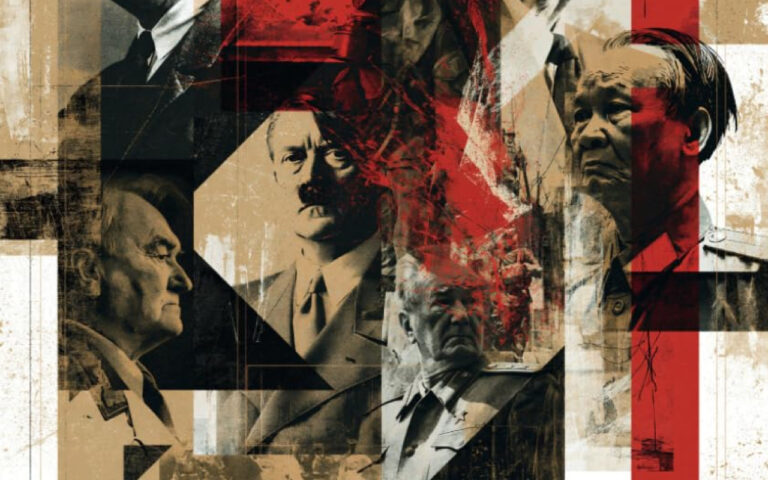
Regardless of what further doses of Annihilation Therapy the future might hold, The Nuremberg System is one of the best books to have come out of the online dissident right scene in some time. It is well-researched, well-argued and highly provocative in its implications. For a self-published book there are remarkably few spelling mistakes and typographical errors, and the graphic design of the covers conveys well the ideological horror show within. If I had one negative criticism to make, it is that the book could have done with additional editing. Often the chapters bounce around between topics without much of a chronological or thematic link, and the length of some of the sentences needs to be seen to be believed. However, these are minor issues that don’t detract in the slightest from the power of the book’s argument. The Nuremberg System deserves attention not only from dissidents, but anyone who ever wondered just how our collective situation in the West got so bad.
Thomas Cyr’s The Nuremberg System: Conceptual Bases of World Order from 1933 to Present can be ordered from Amazon as a paperback or ebook via the following link.
Author’s disclaimer: I paid for my own copy of The Nuremberg System, have no links to the author, and stand to make no money from sales.
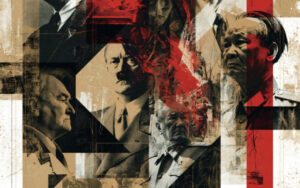
Header image credit: Thomas Cyr.