John Hawkins, University of Canberra and Stephen Bartos, University of Canberra
Australia’s economy expanded by 0.4% in the June quarter, with spending growth driven by record sales of imported electric vehicles.
For the year to June, gross domestic product (GDP) grew by 2.1%, according to the Australian Bureau of Statistics, slightly stronger than market expectations.
The bureau noted overall growth remained subdued, with spending growth and business investment only in “pockets” of the economy. But a significant proportion of this demand was met from imports, rather than production in Australia.
With the economy performing in line with Reserve Bank of Australia forecasts, the national accounts are unlikely to change the outlook for interest rates.
This represents another disappointing quarter, with the economy only growing at the same pace as the population.
In eight of the past 20 quarters, the economy has expanded at a slower rate than the population. So net immigration is propping up an economy that would otherwise be flat.
We are on the edge of what some observers call a “per capita recession”, meaning the average Australian’s living standards are not improving. This may be welcomed by some in what is known as the “degrowth” movement, which questions the desirability of GDP growth.
However, for average Australians it means having to adjust expectations radically, from a world where living standards grow each year to one where they remain static.
The best measure of average living standards – real net national disposable income per capita – is around where it was five years ago.
What’s hot and what’s not
This is the first full quarterly report reflecting the conflict in the Middle East. As it became clear the United States was not achieving a quick victory, and oil prices would be high for an extended period, business and consumer confidence took a hit.
Business investment was flat in the June quarter, but it follows strong growth in recent quarters fuelled by spending on data centres.
Exports were strong, mainly due to a rebound in coal exports after weather disruptions in the March quarter.
Reflecting the strength in mining, final demand growth was strongest in Queensland, Western Australia and the Northern Territory. Victoria had the weakest economy.
Consumer spending is patchy
Surveys of consumer confidence remain weak. Indeed, confidence is not much better than during the depths of the COVID pandemic. This pessimism is reflected in opinion polls showing a majority (58.5%) believe Australia is “heading in the wrong direction”.
Yet, surprisingly, this reported gloom, and three interest rate increases this year, has not hurt consumer spending that much. Household discretionary spending was up 1.4% in the quarter. Other official data suggests this strength has continued into July.
Car sales jumped 10.3%, led by record sales of electric and hybrid vehicles as the surge in petrol prices made their lower operating costs look even more attractive. Anticipating further strong demand, car dealers built up their stocks.
Other areas of discretionary spending were more subdued. Australians cut back on overseas travel, reflecting increased risks and costs since the Middle East war. The bureau said the number of Australians travelling overseas for the northern hemisphere summer fell for the first time since the pandemic.
A question now is whether falls in house prices will further weaken consumer sentiment for the two-thirds of households who have mortgages or own their home.
Data centres frenzy slows
Business investment grew by 10.4% during 2025-26. Investment in the industry group that includes data centres grew by 77%.
That fell away somewhat this last quarter.
But this rapid growth does not translate into an equivalent benefit to the Australian economy. Building the centres increases pressure in an already stretched construction sector. This makes it harder and more expensive to address the housing backlog. Construction costs continued to rise this quarter.
The equipment installed in data centres is almost all imported. And once built, the centres require few workers to operate them. Most of the profits will flow back to the foreign shareholders.
The use of artificial intelligence (AI) may, or may not, lead to a surge in productivity. But that will depend more on whether Australian businesses find smart and creative uses for it, rather than whether data centres are located here.
As Treasurer Jim Chalmers put it this week:
Achieving a higher productivity trajectory depends on how we encourage adoption and diffusion [of AI], uplift skills, attract talent and grasp opportunities.
It is not only AI that matters for productivity. Other business investments, especially in new machinery and equipment, would help. Unfortunately, the national accounts record a fall in business investment in the June quarter, pointing to ongoing weakness in the economy.
Implications for interest rates
The Reserve Bank regards 2% growth as the economy’s “speed limit” and any growth significantly above that would stoke inflation.
We have argued before there is a risk of a 2% growth limit becoming a self-fulfilling prophecy if the bank raises interest rates whenever economic growth looks likely to exceed that number.
The latest forecasts by the RBA were for economic growth across 2025-26 to be 1.9%. So today’s 2.1% rate will not have surprised them much. It’s unlikely to either dissuade them from a further rate rise nor compel them to act.
Financial markets lifted the chances of an RBA rate hike at the September 28-29 meeting to about 70% after the GDP report, up from 50% beforehand.
If the bank does hold in September, whether it moves in November will depend a lot on the September quarter inflation numbers.
John Hawkins, Senior lecturer, Canberra School of Government, University of Canberra and Stephen Bartos, Professor of Economics, University of Canberra
This article is republished from The Conversation under a Creative Commons license. Read the original article.
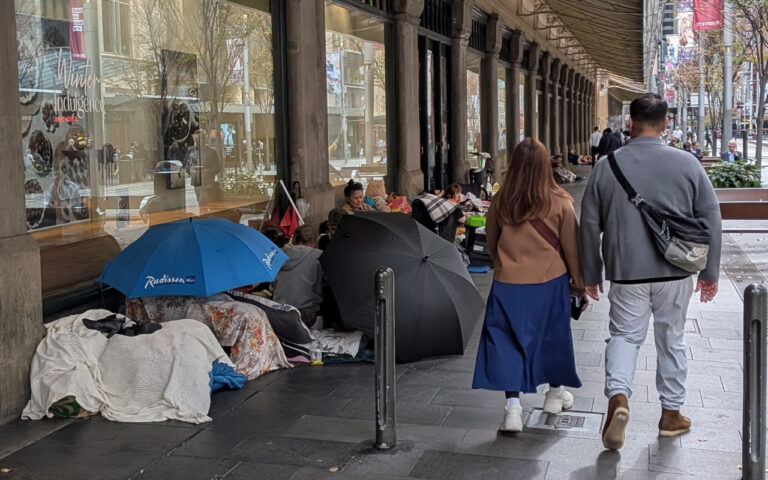
Header image: A homeless encampment outside the Queen Victoria Building in Sydney’s CBD (Noticer News).