The controversial renaming of a Tasmanian electorate after an aboriginal war leader who massacred women and children has been abandoned after the proposal sparked nationwide outrage.
The Australian Electoral Commission confirmed on Monday the renaming of the seat of Franklin to Tongerlongeter would not go ahead, saying more consultation and consideration was required.
Tongerlongeter was responsible for numerous attacks on colonial settlements during the Black War of the 1820s and 30s, and possibly personally led two separate attacks in 1828 where two White women, two little girls and a young boy were speared and clubbed to death.
The AEC said while announcing the proposal last month that although the electorate had been named after explorer Sir John Franklin for 120 years, the change would “honour” Tongerlongeter and his “prominent role in aboriginal resistance to colonial expansion”.
But the plan sparked criticism from former Prime Minister Tony Abbott, and from Australia’s leading Anglo-Celtic advocacy group, the British Australian Community, which called it an “unnecessary and hostile erasure of Australia’s Anglo-Celtic foundations”.
Australian Electoral Commissioner Jeff Pope said on Monday an independent panel had reviewed the proposal, which had received a large number of public submissions.
“The panel considered the case for the proposed name to be very strong – including Tongerlongeter’s strong connection to the area encompassed by the new boundaries of the electorate of Franklin,” Mr Pope said.
“However, public submissions not only indicated a level of disagreement among Tasmanian aboriginal organisations and individuals about the proposed name but also highlighted a broad sentiment that further consultation was required.
“While other name options were put forward, including Mathinna, Rooke and Woureddy, the panel had to reach its final decision based on the evidence and views already received – the redistribution process allows no more time for further consultation.”
The decision was applauded on social media, with many everyday Aussies saying they were glad the renaming did not go ahead.
“Good to see another woke renaming crusade bite the dust,” wrote political commentator Kobie Thatcher.
“Rare bureaucratic W,” wrote John Macgown, the host of popular podcast Stream of Consciousness.
“Good outcome. Happy to remain in Franklin!” wrote another man.
The Tasmanian Aboriginal Centre (TAC) was among the local groups to criticise the proposal, and claimed the AEC has the insurgent’s name wrong, and that it was actually “Tukalunginta”.
TAC campaign manager Nala Mansell said it “makes no sense, for people who fought so fiercely against the establishment of a White political system, to name the same system in their honour”, and said aboriginal people were not consulted early enough.
Tongerlongeter and the leaders of allied aboriginal groups fought the British for about a decade, carrying out attacks which resulted in the killing of men, women and children, the burning of huts and crops, and the theft of livestock and supplies.
Historian Nicholas Clements estimated in his book Black War: Fear, Sex and Resistance in Tasmania that there were more than 219 deaths among White settlers during the conflict.
Reports published in local newspapers at the time detailed two attacks near Lake Tiberias in October 1828 where Anne Geary, a Mrs Gough and her young daughter Alicia Gough, and a boy named John Langford, were brutally murdered by Oyster Bay aboriginals, a group led by Tongerlongeter.
According to the Hobart Town Courier, Anne Geary asked for assistance from the Gough family as her hut was being raided, but after Patrick Gough rode off to help with two other men, an Oyster Bay war party appeared and murdered Anne Geary with an axe and spears.
Patrick Gough’s wife was speared by the aboriginal warriors and later died, and her four-year-old daughter Alicia was murdered with a type of hardwood club called a waddy. The Goughs’ oldest daughter, 7, and youngest daughter, 13 months, were also clubbed but survived.
The Tasmanian described another incident two weeks later where John Langford died of several spear wounds to his groin, neck and right arm, inflicted when an aboriginal war party raided his family’s farm. His mother was speared in the breast and her daughter was speared in the neck, but both survived.
The University of Newcastle’s Colonial Frontier Massacres project states that “23 Oyster Bay warriors, possibly led by Tongerlongter” carried out the attacks, and records another little girl as having been killed during the raids.
“The killing of the two women, the little girls and the boy was the trigger for the proclamation of martial law on 5 November 1828,” researchers stated.
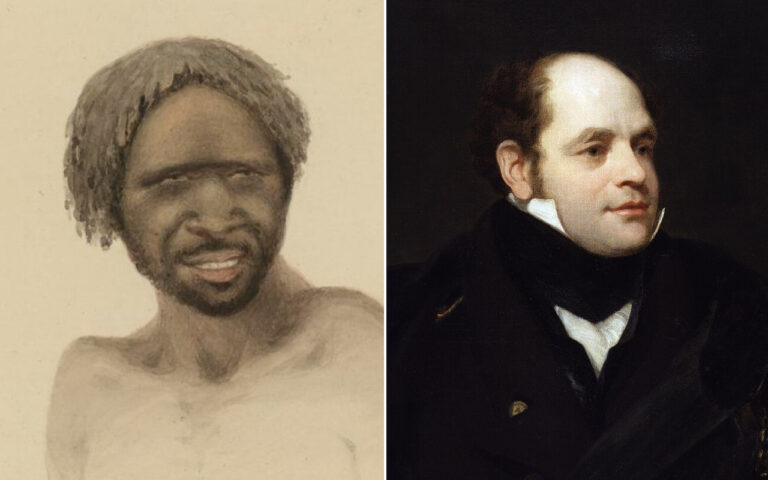
Header image: Left, A watercolour painting of Tongerlongeter (Thomas Bock, 1832 – British Museum). Right, A portrait of Sir John Franklin (Thomas Phillips, public domain).