A NSW Labor MP has criticised the federal government’s prohibited hate group laws, and said Australia needs a constitutional bill of rights to protect freedom of political communication.
Member of the Legislative Council Stephen Lawrence, a barrister and former Mayor of Dubbo, said on Thursday he feared the laws would be struck down by the White Australia Party in the High Court, handing it a political victory against the system and “exposure and publicity that simply cannot be paid for”.
Mr Lawrence said he agreed with a recent analysis by constitutional legal scholar Dr Anne Twomey, who warned any political party could be banned under the legislation, and the failure of members of parliament to respect the Constitution showed the need for a human rights act.
A NSW Labor MP has criticised the federal government’s hate group laws and called for a constitutional bill of rights.
He predicts the laws will be struck down by the White Australia Party in the High Court, which he fears will gift it a “win against the system”. pic.twitter.com/Tk38EU5pTq
— The Noticer (@NoticerNews) May 30, 2026
“I fear the absolutely odious Australian neo-Nazi movement is about to secure a transformative political moment. That gift, I fear, will come in a decision from the High Court striking down the Federal Government’s new hate group laws as inconsistent with the implied freedom of political communication and unconstitutional,” he told NSW Parliament on Thursday.
“These laws vest extraordinary powers in a Minister to ban so‑called hate groups. They do not accord procedural fairness, they do not allow for merit review and they have vague, uncertain criteria. Groups can be banned for non‑criminal conduct engaged in by rogue informal members, and the threat of psychological harm is a basis for proscription.
“Imagine the optics: An avowed Nazi leader, on the steps of the High Court of Australia, launching the White Australia Party on the day the court strikes down the new laws, aimed directly at him and his group, as unconstitutional. A win will not just be a blaze of publicity. More importantly, it is a win against the system, which many Australians believe is rigged against them and operates in the interests of elites.”
Mr Lawrence said the parliamentary debate on the prohibited hate group provisions of the Combatting Antisemitism, Hate and Extremism (Criminal and Migration Laws) Act 2026, which was passed by both major parties after the Bondi Islamic terrorist attack, was “absolutely devoid” of expert opinion.
“Most of the speeches in support consisted of denunciations of extremism and verbalised assumptions that if a law banned something, that would reduce its prevalence in the community,” he said.
“The concept of unintended consequences was not at the forefront. There were also virtually no references in the debate to the implied freedom, let alone the separation of powers or the question of what constitutional head of power was said to support the laws.
“The bill was examined by the Parliamentary Joint Committee on Intelligence and Security, whose final report is also notable for making absolutely no reference to constitutional issues. It really is extraordinary, even in the rushed circumstances of the lawmaking.
“Almost 80 years after the Communist Party case and after decades of Australians dispensing with Nazis at the ballot box, our Federal Parliament took the giant leap of banning political organisations in Australia. The Federal Parliament did so with virtually no real, informed debate – from the major parties, at least. It really is extraordinary and was clearly a political response to Bondi, rather than a considered policy response to the problem of extremism.”
Mr Lawrence then accused Australian politicians of repeatedly failing to respect the Constitution, and said a human rights framework was needed to protect political freedoms from rogue parliaments.
“The effect of making laws that breach human rights and/or the Constitution is serious. It can undermine trust and confidence in government, create resentment and resistance, and even fuel conspiratorial beliefs and movements,” he said.
“The reaction to the COVID response is a case in point. The need for a human rights Act – indeed, a constitutional bill of rights – has never been clearer. Only a clear, express and binding legal framework that protects our fundamental rights will force parliaments to legislate mindfully of those rights and will better reinforce trust between government and the governed.
“Time and again, MPs have simply failed the test that the Constitution imposes on us. We need the help that a proper human rights framework provides.”
The White Australia Party and Thomas Sewell, representing 1,788 former party members, filed a High Court challenge to the laws after it was listed as a prohibited hate group on May 15, and an interlocutory application for the hate group laws to be temporarily suspended while the case is being determined will be heard next week.
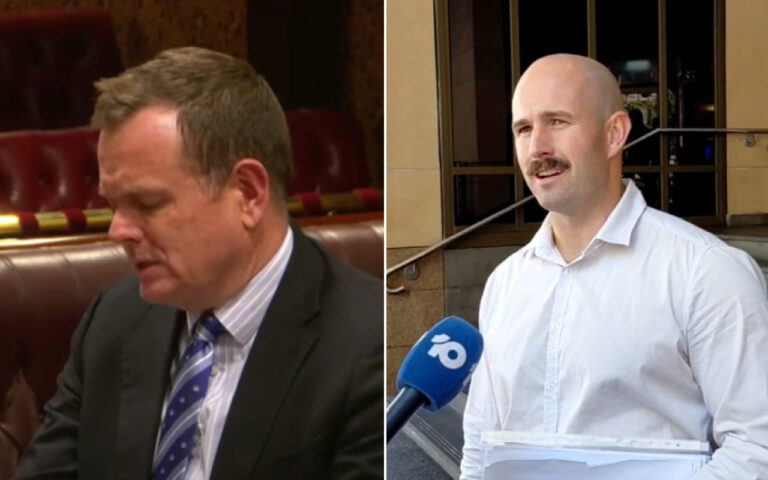
Header image: Stephen Lawrence in parliament (NSW Parliament). Right, Thomas Sewell outside court in Melbourne (supplied).