Adrian Beaumont, The University of Melbourne
Labor expanded its national lead in a Resolve poll as a DemosAU MRP poll had One Nation winning 12 House seats. In Victoria, the Coalition has a 51–49 lead in a Resolve poll. As the SA Liberal leader resigned, a new poll gave Labor a 61–39 lead.
A national Resolve poll for Nine newspapers, conducted December 2–7 from a sample of 1,800, gave Labor a 55–45 lead by respondent preferences, a two-point gain for Labor since the November Resolve poll.
Primary votes were 35% Labor (up two), 26% Coalition (down three), 14% One Nation (up two), 11% Greens (down one), 8% independents (up one) and 6% others (steady). By 2025 election preference flows, Labor would lead by above 56–44.
Anthony Albanese’s net approval improved six points to +6, with 48% giving him a good rating and 42% a poor rating. Albanese’s net approval has surged 12 points in the last two months.
Despite the drop in the Coalition’s vote, Sussan Ley’s net approval jumped ten points to +3. Albanese led as preferred PM by 41–26 (39–25 previously).
On keeping the cost of living low, there was a 31–31 tie between Labor and the Liberals (the Liberals had led by 28–27 in November). Labor led by 36–33 on economic management (31–29 previously).
Given information about Australia’s current migration intake, 53% thought it too high (up four since September), 33% about right (up six) and 4% too low (down one). But just 5% rated immigration their most important issue, putting it sixth on issue importance with cost of living dominating as 42% rated it most important.
The social media ban on children under 16 will start on Wednesday. By 58–35, respondents were not confident it would be effective (68–25 in December 2024). Among the 395 respondents who were parents of children aged 10–15 years, this was tied at 47–47. By 67–15, parents supported the ban.
Poll shows more seats for One Nation
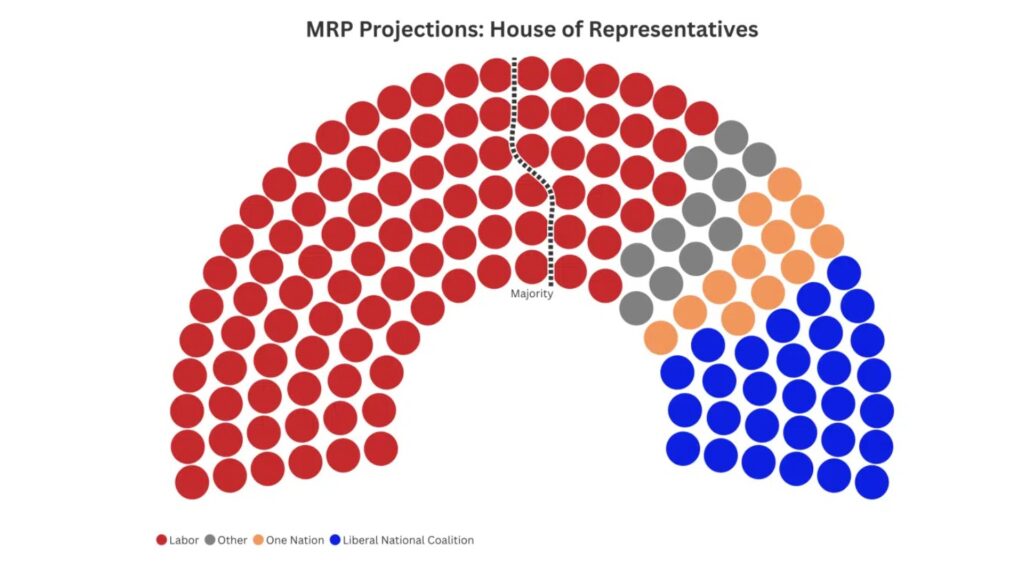
MRP polls use modelling to estimate seat outcomes. A national DemosAU MRP poll, conducted October 5 to November 11 from a sample of 6,928, had Labor winning 98 of the 150 House of Representatives seats (up four since the May election), the Coalition 29 (down 14), One Nation 12 (up 12) and 11 for all Others (down two), with zero Greens (down one).
Nationally, Labor led the Coalition by 56–44 (55.2–44.8 at the election). Primary votes were 33% Labor (34.6% at the election), 24% Coalition (31.8%), 17% One Nation (6.4%), 13% Greens (12.2%) and 13% for all Others (15.0%).
The slump for the Coalition since the election and the surge for One Nation is allowing One Nation to win seats where the Coalition is third on primary votes behind Labor and One Nation. Coalition preferences then assist One Nation.
Coalition gains to lead Victorian Resolve poll
The Victorian election will be held in November 2026. A Resolve poll for The Age, conducted with the federal November and December Resolve polls from a sample of over 1,000, gave the Coalition a 51–49 lead by respondent preferences. Resolve doesn’t usually give a two-party estimate for its state polls.
Primary votes were 39% Coalition (up six since October), 28% Labor (down two), 12% Greens (steady), 9% independents (down one) and 11% others (down four). The Coalition’s primary vote was 39% in November, before Jess Wilson replaced Brad Battin as Liberal leader, and 37% in December.
Wilson’s net likeability was +14, the highest for a Liberal leader since Resolve started polling in 2021. Labor Premier Jacinta Allan’s net likeability improved four points since October to -17. Wilson led Allan as preferred premier by 41–24 (33–27 to Battin previously).
By 78–9, respondents supported the government’s proposal for young people to be judged and sentenced as adults for certain crimes.
Also in Victoria, a Freshwater poll for The Herald Sun, conducted November 21–24 from a sample of 1,220, had a 50–50 tie, a one-point gain for Labor since the previous Freshwater poll that was conducted in mid-November, before Wilson replaced Battin.
Primary votes were 37% Coalition (steady) and 30% Labor (steady) with no other parties listed. Allan’s net favourability was down four points to -32, while Wilson’s net favourability was +15, the same as Battin’s. Wilson led Allan as preferred premier by 47–31 (Battin had led by 45–34).
While both the Resolve and Freshwater polls are close on voting intentions, Wilson’s big lead as preferred premier and Allan’s poor ratings suggest it will be difficult for Labor to retain government next November.
SA Liberal leader resigns as poll has huge Labor lead
Last Friday South Australian Liberal leader Vincent Tarzia resigned, with Ashton Hurn elected unopposed as Liberal leader on Monday. Tarzia is the third state Liberal leader to resign or be ousted since November 18, after Battin in Victoria and Mark Speakman in New South Wales.
The SA election will be held on March 21. A poll by new pollster Fox & Hedgehog, conducted November 24 to December 5 (before Tarzia’s resignation) from a sample of 1,000, gave the incumbent Labor a 61–39 lead from primary votes of 41% Labor, 21% Liberals, 13% One Nation, 12% Greens and 13% for all Others.
Premier Peter Malinauskas had a 51–19 approval rating, while Tarzia was at 25–17 disapprove. Malinauskas led as preferred premier by 54–18. SA Labor was at 43–27 approve, while the SA Liberals were at 36–25 disapprove.
The best-rated federal politician in this SA-only poll was One Nation leader Pauline Hanson (38–36 approve). Albanese was at 41–33 disapprove and Ley at 29–16 disapprove. Labor won SA by 59.2–40.8 at the federal election, four points above their national result. With Albanese at +6 net approval in the national Resolve poll, this poll is implausible.
A DemosAU SA poll in October gave Labor a blowout 66–34 lead, and a YouGov poll in May gave Labor a 67–33 lead.
WA DemosAU poll has big Labor lead
DemosAU has the first Western Australian state poll since Labor easily won the March election. It gave Labor a 56–44 lead (57.1–42.9 at the election). Primary votes were 41% Labor, 30% Liberals, 6% Nationals, 13% Greens and 10% for all Others. This poll was conducted November 10–26 from a sample of 1,012.
Labor premier Roger Cook had a +8 net favourability, with 35% giving him a positive rating and 27% negative. Liberal leader Basil Zempilas was at -3 net favourability (33% negative, 30% positive). Cook led by 47–34 as preferred premier.
Labor’s big lead came despite very poor net approval of -53 for its handling of both housing and cost of living, which were the two most important issues.
Adrian Beaumont, Election Analyst (Psephologist) at The Conversation; and Honorary Associate, School of Mathematics and Statistics, The University of Melbourne
This article is republished from The Conversation under a Creative Commons license. Read the original article.
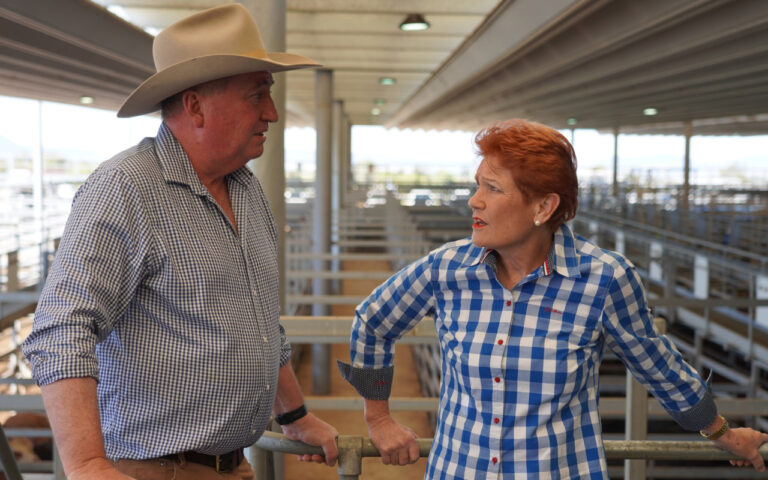
Header image: Pauline Hanson with new One Nation recruit Barnaby Joyce (Facebook).