Stella Huangfu, University of Sydney
The Reserve Bank of Australia (RBA) has lifted the official cash rate by another 25 basis points, the third hike this year as it struggles to keep inflation under control.
The increase takes the cash rate to 4.35%, and fully reverses the three rate cuts delivered in 2025. The hike had been widely expected by economists after a sharp rise in inflation figures last week. RBA Governor Michele Bullock told a media conference:
Inflation in Australia was already too high before the recent conflict in the Middle East began. We must get on top of inflation now so it doesn’t get get away from us.
Why the RBA moved
The reason is clear: inflation is too high. The latest figures showed annual consumer price inflation rose to 4.6% in March, up from 3.7% in February.
The jump was driven heavily by higher fuel prices triggered by the war in Iran, which began on February 28.
The RBA cannot simply dismiss this as a temporary oil price shock. Its preferred measure of underlying inflation, the trimmed mean, was still 3.3% in March. That is above the RBA’s 2–3% target band. It suggests price pressures are not only coming from petrol prices, but are spreading across parts of the domestic economy.
As the RBA noted in its post-meeting statement,
Higher fuel prices are adding to inflation and there are indications that this is likely to have second-round effects on prices for goods and services more broadly.
This is why the RBA acted. Higher interest rates will not produce more oil, bring down global shipping costs, or end geopolitical conflict. But they can reduce demand in the economy and, just as importantly, signal that the RBA will not allow a temporary price shock to become a lasting inflation problem.
The increase will add about $100 to monthly repayments on the average new mortgage loan of A$700,000.
Another split vote
The decision was again split, with eight members voting to raise the cash rate and one voting to keep it unchanged. “We had a lot of debate,” Bullock said.
The 8–1 vote shows there was a strong majority in favour of acting on inflation, but not complete agreement. Most members appear to have judged that the risk of inflation staying above target outweighed the risk of weaker growth.
The policy dilemma: rising inflation, slowing growth
The move comes just a week before the federal budget, with reports the government is considering further cost-of-living support with an “earned income offset” for wage earners of $200 to $300.
The potential extra spending adds to the policy dilemma facing the RBA: inflation is rising, but the economy is likely to slow. And consumer confidence has collapsed to recessionary levels, risking a further slowdown in spending.
In the worst case, Australia could face a mild form of stagflation – a situation where inflation remains too high while economic growth weakens. This is one of the hardest environments for a central bank to manage.
When inflation is high because the economy is growing too strongly, the solution is more straightforward. Higher interest rates cool demand, slow spending and help bring inflation down.
But today’s problem is more complicated. Higher interest rates will not ease the oil supply shock. They can only work by slowing domestic demand.
That means the RBA faces a difficult trade-off. If it does too little, inflation could stay high for longer and expectations could become harder to control. But if it does too much, it risks pushing the economy into a sharper slowdown or even a recession.
This tension was clear in the RBA’s assessment of the outlook:
Australian GDP growth is forecast to be a little lower than previously expected due to higher fuel prices and the assumed higher path for interest rates.
Inflation to stay higher for longer
The updated quarterly forecasts released with today’s decision underline this difficulty.
In February, before the war began, the RBA expected headline inflation to peak at 4.2% and underlying inflation to peak at 3.7% in June.
It now expects headline inflation to peak at 4.8%, with underlying inflation reaching 3.8% at the same time.
This upward revision means the RBA is no longer looking at a gradual return of inflation to the target band. It is now dealing with a renewed inflation shock, on top of domestic price pressures that had not yet fully disappeared.
The risk is that higher fuel prices feed into broader prices and wages. If that happens, inflation could become harder to bring down, even after the original shock fades.
That is why the RBA has moved again. It wants to prevent a temporary global price shock from turning into a more persistent inflation problem.
What it means for households and government
The RBA’s message is uncomfortable but clear. It is prepared to accept a weaker economy and a softer labour market if that is what is needed to return inflation to target.
For households, the rate rise will increase repayments for borrowers on variable-rate mortgages and put more pressure on household budgets.
For the government, it means fiscal policy needs to be careful in next week’s budget. Any cost-of-living support must be designed in a way that helps vulnerable households without adding too much extra demand to the economy.
The narrow path ahead
Today’s decision was not an easy one. The RBA is trying to stop a temporary global shock from becoming a permanent inflation problem.
But the more it raises rates, the greater the risk that the economy slows more sharply than expected.
That is the narrow path the RBA is now walking: doing enough to control inflation, without doing too much damage to growth.
Stella Huangfu, Associate Professor, School of Economics, University of Sydney
This article is republished from The Conversation under a Creative Commons license. Read the original article.
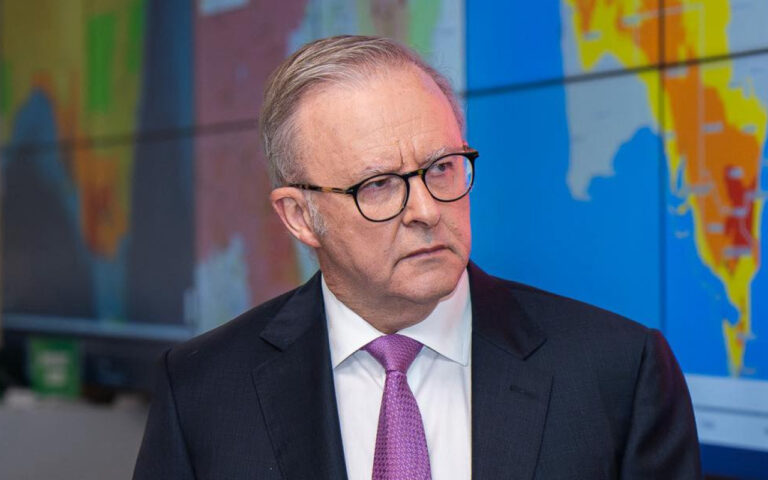
Header image: Prime Minister Anthony Albanese (PMO).