One of the results of the rise of One Nation has been a renewed focus on electoral arithmetic on the Australian right. By how much will One Nation erase the Liberal vote? What will happen with preferences? Is a Liberal-National-One Nation coalition inevitable?
Yet the longer-term problem facing the Australian right is democracy itself.
Like most of the rest of the West, we in Australia live in a representative democracy. The ostensible appeal and legitimacy of this system is its basis in popular sovereignty – i.e. ultimately it is we the people (the demos) who get to vote and decide who rules us via regular elections.
The obvious problem with this formula is who is the people? To whom does the demos refer in a democracy? Like the proverbial fish that is unaware it is in water, this question used to be so obvious in Australia it did not require elaboration. For most of our history, the franchise meant men, and later women, of predominantly British and northern European descent, and then aboriginal Australians since the 1960s.
This changed slightly after the post-war migration waves of southern and eastern Europeans and latter groups like the Vietnamese. Primarily, however, up until recently the Australian demos was composed of people of mainly Anglo-European origin and the political contest was implicitly conducted on this basis.
Given such, our politics was a relatively mild affair centred on social and economic concerns. The Liberal Party were the better economic managers and the choice of the upper classes. Labor were the party of the working man and of those wishing to take the edge off of Australian capitalism. The Nationals were the party of rural and regional Australia.
Those simpler political times are now gone. As a result of the last few decades of mass migration and multiculturalism, the cooler political climate of a more homogenous country has given way to a hotter and more existential politics revolving around “identity” and ethno-racial concerns.
This was always going to happen. The oft-repeated idea that “Australian multiculturalism was different” was plainly an anti-natural delusion and a lie – a notion that anyone with an ounce of historical or global knowledge could have easily told you.
Indeed, all Australians needed to do was to look to Singapore and its former leader Lee Kuan Yew to note the reality of multiethnic democracy. As Lee explained to Germany’s Der Spiegel in 2005:
“In multiracial societies you don’t vote in accordance with your economic interests and your social interests, you vote in accordance with race and religion.”
And so it now is in Australia too.
Consider just a few of the myriad examples of how our demos is fracturing along ethno-cultural lines. Take a recent Demos AU poll which showed that among LOTE (Language Other Than English) speakers combined support for the left-leaning ALP-Greens gained a majority of 53%, while support for the right-leaning LNP-ON held just 42%.
The situation for native English-speakers was the reverse, with the LNP-ON polling 54% and the ALP-Greens just 35%. In essence, the more cosmopolitan the cohort, the greater the support for the left and the harder things are for the right.
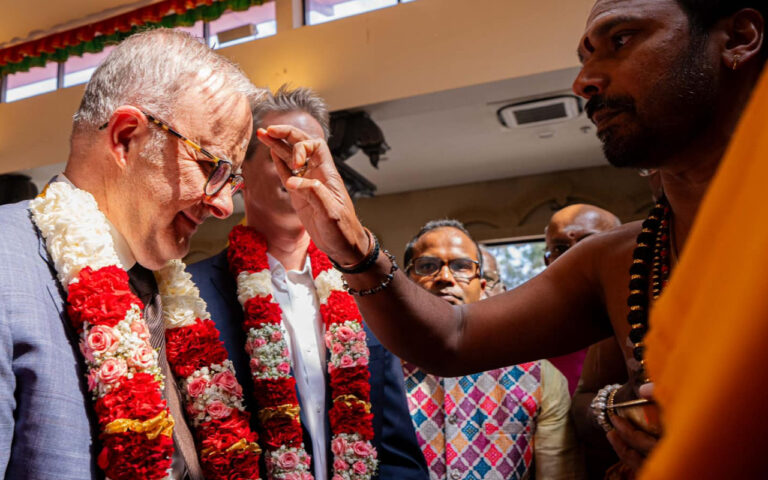
This basic trend of a multicultural left and a homogenous right is seen in any number of other cases. Take the now-famous quote by pollster Kos Samaras that “85% of Australia’s Indian diaspora voted for the Labor Party at the last election”. Or take the huge electoral swings to Labor from Australia’s Chinese community over the Liberals’ “hawkish rhetoric” on China, or the fact that Chinese-born Australians opt for Labor over the LNP by a rate of 14%.
Yet this will only get worse. Here, for instance, is Nine Newspapers political editor Peter Hartcher talking after the Federal Budget about the demographic dilemmas plaguing the LNP. As Hartcher writes, the Coalition are facing an existential crisis trying to prop up an ageing electoral base of Baby Boomers and older Australians that is literally “a dying demographic”.
Such a geriatric focus will inevitably alienate the LNP from Australia’s faster-growing and more diverse younger cohorts, with “voters under the age of 45 – Millennials and Gen Zs – [already] the majority of the electorate”.
This will again be exacerbated by the next election when “there will be 700,000 more Millennial voters on the electoral rolls than there were at the last”, with Hartcher adding that according to polling done by Samaras’ own Redbridge group, among young Australians “only one in five consider themselves Coalition voters … and that’s on a good day”.
This calculation will only sharpen as Australia heads towards an immigration-driven population of over 30 million, and our major cities are transformed into majority-minority status. Indeed, this is already effectively the case with the Liberals having been essentially electorally banished from urban Australia for the last two elections.
This does not bode well for anyone conservative or on the right, nor for the average non-political Australian who liked the country as it was and who wants Australia to remain majority Anglo-European culturally and demographically.
Democracy as now practiced is, therefore, little more than a slow-motion mechanism to transform Australia for the worse, to steadily unravel the social fabric, and to undo everything that made the country great and such a beacon for migrants in the first place.
For those who are not concerned by such trends, consider the following: under an ever-more diverse yet still-democratic Australia, which would prevail in a popular vote?
- Support for America as the global hegemon or China?
- Support for a pro-European immigration policy or a non-European?
- Support for Israel or Islamic Palestine?
- Support for Western culture and civilisation or non-Western?
- Support for reparations payments from European Australians or not?
Even to ask these question is to answer them. Democracy as it stands is inherently a left-leaning political vehicle and a neutering program for an older, traditionalist version of Australia and the broader right.
Indeed, this in-built democratic advantage is one of the main reasons why the ALP control six of Australia’s nine main governments, and how states like Victoria can have record crime rates and utter social decay yet still see Labor win elections.
This basic phenomenon of diversity leading to near-permanent leftist rule has also been seen overseas.
In California, waves of legal and illegal migration have transformed the former home of Nixon and Reagan into a Democrat stronghold, with the state last voting for a federal Republican in 1988. In London, as the city has become one of the most multicultural places on the planet and its historic inhabitants reduced to a minority, the city has been led by a Muslim Labour Mayor for the last 10 years and three elections straight.
The demographic explanation for these and related trends was always there for those with eyes to see.
In 2002 American analysts John Judis and Ruy Teixeira wrote a book called The Emerging Democratic Majority which explained how “structural demographic shifts”, including “growing minority populations”, would lead to left-wing or progressive dominance.
Confirming this pattern, former US President Barack Obama said in an interview with the New Yorker in 2016 that the Democrats and cultural left were “well positioned” as “each year, the demographic improves”. Or as the interviewer more bluntly put it, the prospective for progressives was positive as the “non-White percentage of the population will continue to increase”.
This is the basic calculus of the ALP and the Australian left as well. One need only note the mass citizenship ceremonies conducted by Labor before the last federal election, or the party’s machinations in states like Victoria. In fact, south of the Murray, the ALP are increasingly blatant in their efforts to influence the state’s demography for their own ends.
Here, for instance, is a list released by the Victorian Liberals detailing Labor’s “grey corruption of taxpayer-funded Multicultural events”. As the list outlines, ostensibly bi-partisan events such as multicultural galas and Lunar New Year festivals have become little more than one-sided ALP outreach and patronage programs in which Labor ingratiates itself with the state’s many multicultural communities.
As Victorian Liberal spokesman Evan Mulholland said of this practice, he was concerned that “taxpayer-funded community events are being used to advance the political interests of the Labor Party in an election year”, and that he had written to Victorian Premier Jacinta Allan asking her to “immediately end the practice and ensure multicultural community events are open and inclusive of all elected representatives”.
To repeat one more time: this, and almost only this, is why Labor and the left now dominate Australia and why the LNP and the right have been reduced to an increasingly inept state. Labor are plainly not better at governing the country than the Liberals – indeed, Australia has recently seen one of the largest declines in living standards in the developed world.
What Labor and the left are better at, however, is knowing that in a multicultural democracy all you need to do to win elections and wield power is to cobble together a governing majority of assorted ethnic and cultural groups – often via the arousal of underlying ethnic animus and a mutual hatred of the political right.
Again, none of this should be a surprise. Major thinkers have warned of the problems inherent to multicultural democracies for millennia. For Aristotle, diverse societies lacked “philia” or the “fellow-feeling” and natural love and affection that only arises in homogenous societies and which is a prerequisite for democracy.
For German theorist Carl Schmitt, diversity and democracy were completely antithetical and attempting to mix them was a contradiction in terms. As Schmitt wrote in his 1923 book The Crisis of Parliamentary Democracy: what any real “democracy requires [is] first homogeneity”.
Schmitt again emphasised the centrality of homogeneity to democracy – and thus the restriction or reduction of heterogeneity – by further noting that “every actual democracy rests on the principle that not only are equals equal but unequals will not be treated equally”.
Interestingly, Schmitt cites early 20th Century Australia under its Eurocentric – or White Australia – migration policy as an example of a state that was able to maintain a democratic system by enforcing a largely homogenous population policy. As Schmitt wrote, the Australia of the time only took “emigrants who conform to the notion of a ‘right type of settler’”.
As an example of the inability of multicultural democracy to deal with the conflicting, and often irreconcilable, demands that it naturally creates, we may note the present situation of the Australian state vis-à-vis the war in Gaza and the broader conflict between the Israeli-Jewish and Arab-Islamic communities.
As things stand, the Australian government is unable to directly state that it and the Australian community explicitly prefer one side – say, the Israeli-Jewish side – over the other, or that one side is objectively better than the other, as it has to worry about the democratic “blowback” and negative sentiments of the other.
This is why many Labor MPs – and especially those in heavily Islamic seats in western Sydney and northern Melbourne – are equivocal on this matter as they are now permanently forced to have one eye on the “Muslim vote”.
This demographic pressure in our multicultural democracy also explains such recent but historically anomalous events as the return of the so-called ISIS brides to Australia and Labor’s decision to formally recognise a Palestinian state.
All this is now of a piece with the problems facing Anglo-European Australians under multicultural democracy. As a group, we are increasingly unable to advocate for or uphold our own interests. As one cohort among many, our voice is steadily being diminished under the logic of the system. A fact that is now proven by the widespread and largely unpunished destruction of our statues and monuments, especially on occasions such as Australia Day.
Yet the demands of Anglo-European Australians do not even have to be that radical. The simple advocacy of pro-Western cultural concerns – such as preferring British comedy, classical architecture or Italian cuisine to their non-Western alternatives – is increasingly seen as illegitimate or a minority position under the current cosmopolitanism.
Yet at things stand, this demographically diverse democracy is what we seem stuck with, and alternatives to it are still viewed as suspicious, taboo, or outright illegal.
Still, our future under multicultural democracy seems to inevitably be the one described above.
Under diversity and democracy Australia will inextricably shift from a pro-Western, pro-America, pro-Christian and pro-European stance towards something else.
Whether this is a price worth paying to “maintain our sacred democracy” is doubtful in the extreme.