The Australian government continues to shrink foreign student numbers via record rates of visa refusals, with those from India and Nepal the worst affected.
The international student intake has been slashed by more than a third since the end of the COVID pandemic, with the figure falling from a high of 577,295 in the 2022-23 financial year to 371,564 last financial year – or a 35% reduction.
This number is set to fall even further this year, with only 247,878 student visas handed out during the first nine months of this financial year, with overall student visa approval rates falling from 75% last year to 70.5% in March.
The rate of student visa rejections for Indian applicants has risen from one-in-three rejections in March 2024 to almost half of all Indian applications being denied this year, The Australian reported.
The approval rate for Nepalese students also declined dramatically, decreasing by almost half from 81.7% in March 2025 to just 42.3% this year, while the trend for Bangladeshi applicants was similar, falling from 86.6% in March last year to 59% in March this year.
These reductions come as part of a broader effort by the Australian government to cut foreign student numbers, with a spokesman for higher education advocacy group Universities Australia confirming that visa refusal rates have jumped from 6% to 26% over the past three quarters.
“Refusals from six South Asian countries – Bangladesh, Bhutan, India, Nepal, Pakistan and Sri Lanka – are around four times higher over November to March, implying Semester 1 commencements could be up to 17% lower compared to 2025,’’ the spokesman said.
Student visa rules for India, Nepal, Bangladesh and Bhutan were quietly tightened in January amid concern over a fake Indian degree bust late last year, with police in Kerala warning criminals may have supplied fake documentation to 1 million people across India.
This increase in refusal rates and fall in foreign student numbers is it to result in millions in lost revenue, with the spokesman adding the cuts to these six South Asian nations are set “to cost the sector $1.4bn over the duration of study, with a further minimum $1bn impact on the wider economy over the same period’’.
Chief Executive of Universities Australia and former ALP advisor Luke Sheehy said that international education was one of Australia’s “great success stories” and that “what the sector needs now is stability, certainty and a clear long-term strategy”.
“Australia cannot afford another race to the bottom driven by stop-start policy settings, political signalling or measures that damage our sector, our economy or our global reputation”, Mr Sheehy said.
The National Tertiary Education Union (NTEU) also criticised the cuts, with president Dr Alison Barnes claiming if a future Coalition government reduced numbers further it would be a “potential nightmare for universities” that would do little to address Australia’s current housing and accommodation issues.
“Fewer international students won’t fix the housing crisis”, Dr Barnes said.
“More often than not they’re living in accommodation like extra bedrooms, on campuses or other rooms that locals don’t want to or can’t live in.’’
Calls to further reduce Australia’s foreign student intake, which makes up a third of net overseas migration, come amid broader concerns around immigration and national identity in Australia, with recent record-high immigration rates resulting in significant rises in housing and rental costs, and a surge in support for right-wing populist party One Nation.
Increasing public concern has also been registered in Australia over the country’s dependence on international students, with queues of foreign students recently seen at Melbourne food banks, widespread cheating reported on the country’s campuses, and some domestic universities now seeing 50 percent of their student cohort composed of foreign students.
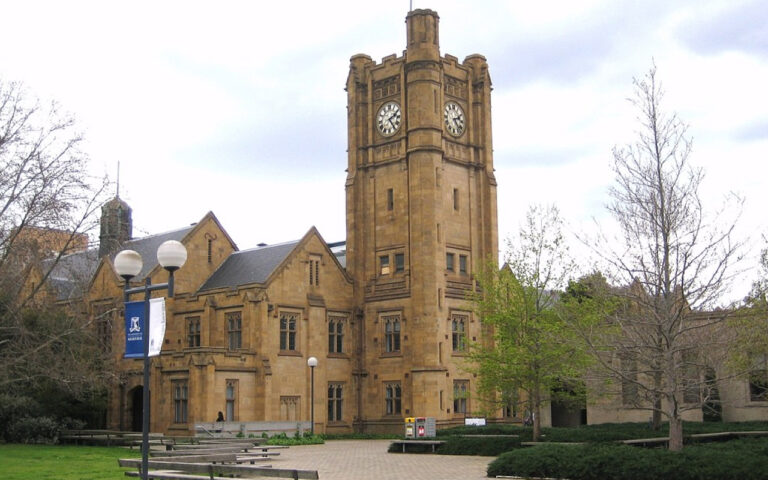
Header image: The University of Melbourne (Polly clip – Own work, CC BY-SA 3.0, Link).