Australians are leaving Sydney and Melbourne for other parts of the country amid record-high immigration levels under Labor, official data shows.
In the 2024-25 financial year more than 33,000 residents fled Sydney and 8,500 abandoned Melbourne, with Adelaide, Hobart, Darwin and Canberra also experiencing net negative internal migration, the Australian Bureau of Statistics revealed last week.
During the same period net overseas migration in Sydney was 78,000, in Melbourne it was 81,000, and in Adelaide it was 18,000. Brisbane’s population grew by 34,000 due to overseas migration and 11,000 from internal migration, while the figures for Perth were 37,000 and 8,000 respectively.
Natural increase was highest in Melbourne, followed by Sydney, Brisbane and Perth, but in all four cities births were heavily outnumbered by immigrants.
Net overseas migration nationwide was 306,000 in 2024-25 with 568,000 arrivals, and since Prime Minister Anthony Albanese became Prime Minister in May 2022 an estimated 2.47 million immigrants have arrived, with net overseas migration at 1.5 million.
Similar trends were seen in data from the 2023-24 and 2022-23 financial years, with net overseas migration of 156,000 and 121,000 in Sydney compared to net negative internal migration of 38,000 and 41,000, while in Melbourne the equivalent figures were 146,000 and 121,000 compared to -7,000 in both years.
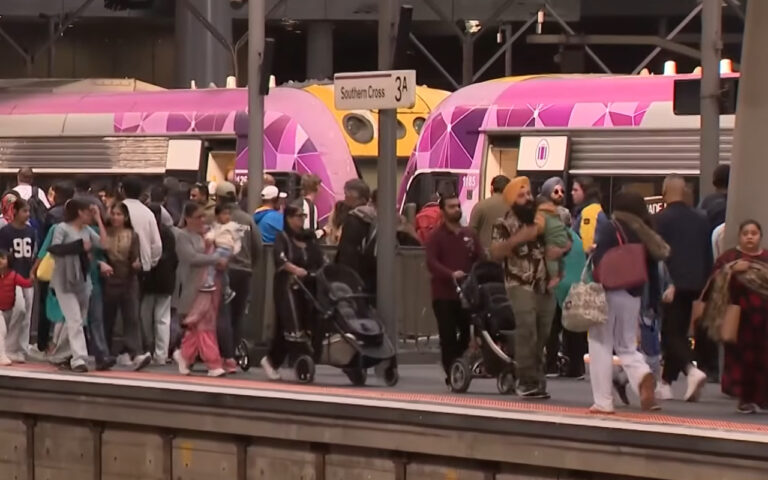
The rapid population growth has resulted in rising rents and house prices along with increased pressure on infrastructure and services such as public transport, with 9News reporting this week that Melbourne’s overcrowded rail network was struggling to cope in the lead-up to the Easter long weekend.
Phil Browning, ABS head of demography, said on Tuesday that capital city population growth was still being driven by net overseas migration.
“Australia’s capital cities grew by 1.8% last financial year, adding 324,700 people. This was almost 100,000 people less than in 2023–24, when the capital cities grew by 2.3%,” he said.
“Net overseas migration remained the main driver of capital city growth despite falling by 109,400 people compared with the previous year.”
Perth had the highest growth rate of all capitals (2.4%), followed by Brisbane (2.1%) and Melbourne (2.0%). Darwin was the only capital that grew faster (1.7%) than the previous year (1.5%).
Header image: Crowds at Melbourne’s Southern Cross Station this week (9News).