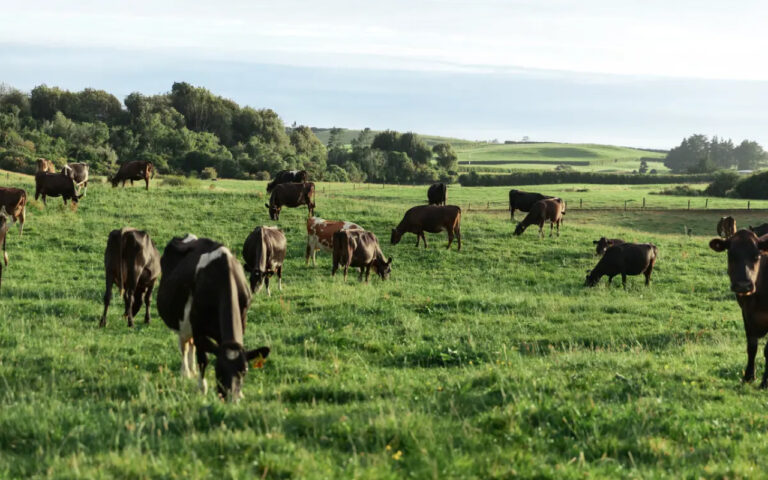
A US agricultural biotech firm is planning to inject cattle in New Zealand with a methane-reducing mRNA vaccine, financed by the government and a clean energy organisation founded by Bill Gates, as part of efforts to combat “climate change”.
Boston-based start-up ArkeaBio last month raised $15 million in a funding round led by taxpayer-funded public-private investment partnership AgriZeroNZ and Gates’s Breakthrough Energy to continue the development of the vaccine and starting selling it to farmers by 2028.
The vaccine works by forcing a cow’s immune system to make antibodies that neutralise methane-producing microbes in the animal’s stomach, and ArkeaBio says early trials show it reduces methane emissions by 10-15%, which it hopes to increase to over 40%.
ArkeaBio CEO Frank Wooten told AgFunderNews the latest funding round would take the company through to its first commercial product, and that farmers were more likely to embrace a vaccine rather than a feed additive, such as controversial methane-reducing supplement Bovaer.
“The majority of animals outside of the US are actually not ever put on feed, so when we look at a solution for a broader global market, the ability of a vaccine to have impact not only at an animal level, but in the workflows of our customer base, is the most elegant way to get that uptick in adoption,” he said.
Mr Wooten also said that the vaccine could result in cows producing more milk and meat using excess hydrogen that would normally be converted into methane by the affected microbes, but not in its first commercial form.
“We’ve seen early evidence of increases in the microbial communities in the cattle rumen that produce volatile fatty acids but we don’t anticipate any measurable effect on productivity until the methane reduction number is above 30%. And for our first product we’re looking at something closer to 10-15% reduction in methane,” he said.
“The other thing we are aggressively looking at is the coformulation of vaccines, where you hit an animal with one vaccine that targets a number of things, so we are actively looking at a couple of very common dairy vaccines that are utilised by 99% of dairy cattle in New Zealand, for example.
“We would look to co-formulate our vaccine with those vaccines. Then the cost burden of the additional methane inhibiting vaccine drops. And our ability to offset that cost, whether it’s with a carbon credit, a premium, or productivity gains, suddenly becomes much more attainable. And as such, we think it becomes a much more attractive product.”
Mr Wooten said ArkeaBio expected to submit an application for regulatory approval in 2027, having spent the past two years working with the government on the process, and wants to be generating revenue the following year.
Breakthrough Energy says on its website that it hopes ArkeaBio’s product can become “the vaccine for climate change” and be rolled-out worldwide.
“There’s a high scientific risk here and it may not work. But it’s hard to overstate the potential impact of this vaccine. We know this technology is highly scalable,” the website states.
“Look no further than the massive effort to administer nearly 14 billion COVID-19 vaccines in three years. If successful, ArkeaBio’s vaccine could become one of the most important climate breakthroughs.”
Header image credit: AgriZeroNZ.