Service stations across Australia are running dry with fuel predicted to hit $4 a litre, while experts have blamed both major parties for shutting down refineries and focusing on renewable energy.
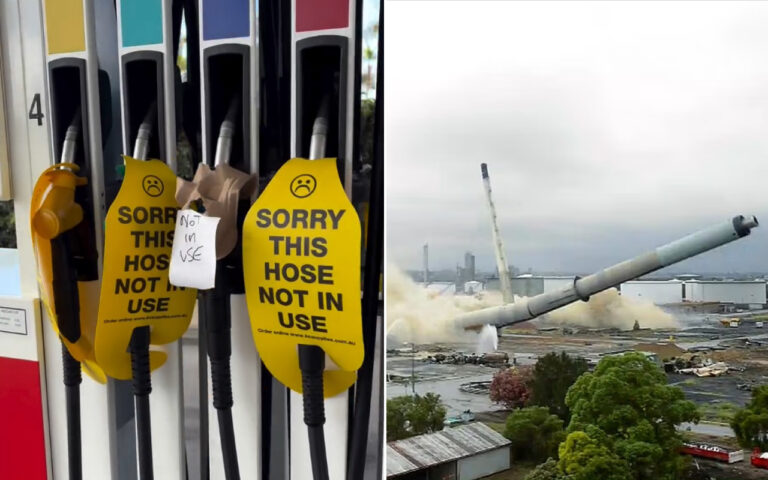
Video from a petrol station on the Gold Coast shows every pump in sight shut down, and the driver who filmed the clip told Noticer News only one out of 12 bowsers was still in operation, and dozens are completely out of fuel in regional areas of NSW, while 105 are without diesel, Premier Chris Minns said.
Energy Minister Chris Bowen confirmed 166 service stations nationwide had run out of at least one type of fuel, but did not have detailed figures on Western Australia, the Northern Territory, or Tasmania when asked about the numbers in parliament.
The Albanese government warned on Monday it could not rule out fuel prices hitting $4 a litre due to US-Israel strikes on Iran that have led to the closure of the Strait of Hormuz, impacting 20% of the world’s oil supply.
Petrol stations across Australia are running out of fuel, the government has admitted prices are set to hit $4/L, and experts are blaming both major parties for shutting refineries.
“Dumb way to run a country” pic.twitter.com/45EOgtZDY4
— The Noticer (@NoticerNews) March 23, 2026
“I can’t speculate on what’s going to happen with prices, but obviously, the longer the conflict goes on, the more potential it has to restrict supplies and push up prices,” Assistant Foreign Affairs and Trade Minister, Matt Thistlewaite told Sky News when asked about the $4 mark.
“This conflict is having an effect, and the longer that it goes on, the more destabilising it could be.”
Macquarie Business School lecturer Dr Lurion De Mello and former defence and energy adviser John Blackburn both told the Daily Mail that the closure of Australia’s oil refineries had left the country vulnerable and at risk of running out of fuel within weeks.
Mr Blackburn said the dismantling of Australia’s refining sector was a result of political stupidity, pointing to the closures of plants at Port Stanvac in 2009, Clyde in 2012, Kurnell and Bulwer Island in 2014, and BP’s Kwinana and ExxonMobil’s Altona refineries in 2021, leaving just two facilities in Brisbane and Geelong.
“What a dumb way to run a country,” he said.
“We could have actually prepared for this, not unaffordably, there’s things we could have done, but neither side of politics was prepared to do it.
“We’ve gone from producing 40% of our own fuels down to 10. We’ve gone from seven refineries to two. It doesn’t take a genius to see the whole system has got worse while the politicians fiddle around the fire.”
He also warned that Australia’s supply chains were dependent on foreign-flagged vessel, more than half of which are Chinese owned, and said rationing was now in the horizon.
Dr De Mello agreed that the Australian government has been “asleep at the wheel” and that the major parties had been aware of the problem for decades.
“For Australia, the consequences are particularly acute. If the crisis at Hormuz continues for weeks or spreads further, genuine shortages become plausible. This is not a theoretical scenario. It is a foreseeable consequence of failing to build resilience,” Dr De Mello said.
“We’ve pumped money into renewables but we’ve kind of missed the plot because for the next 15-20 years we’re heavily dependent on fuel.”
“There was a report done in 2008 that was submitted to the government where it was warned that we have to have a greater amount of fuel storage if you’re going to close down all the refineries.”
The warnings come after the trucking industry said rising fuel costs had already forced fleets off the road and would result in empty supermarket shelves and grocery price spikes by mid-April.
Header image: Left, empty petrol pumps on the Gold Coast (supplied). Right, the Clyde refinery being demolished in 2012 (9News).