David S G Goodman, University of Sydney
Last weekend, China’s Ministry of National Defence announced that the country’s two most senior generals – Zhang Youxia and Liu Zhenli – would be removed from office and placed under investigation for serious disciplinary violations.
Zhang had been the People’s Liberation Army’s most senior general since October 2022. He was the highest ranking military member of the Politburo of the Communist Party of China (CCP), the party-state’s 24-member executive policy-making body.
Zhang was also the senior vice chairman of the Central Military Commission, which controls the armed forces.
Liu was the former commander of the PLA’s Ground Force and had most recently been in charge of the Central Military Commission’s Joint Staff Department.
The reaction to these developments outside China has led to dramatic headlines. A BBC headline initially focused on a “military in crisis”, while the Australian Broadcasting Corporation called it an “astonishing” purge that leaves Chinese leader Xi Jinping almost alone at the top of the world’s biggest army.
Certainly, the moves were surprising. But so little is known about the internal workings of the CCP’s leadership, including Xi’s relations with his colleagues in the Politburo, that interpreting these developments is difficult, if not impossible.
What we know
For historical and political reasons, the PLA is an organisation of the CCP. Both fall under the direct purview of Xi, who is chair of the Central Military Commission, general secretary of the CCP and president of the country.
The removal of Zhang and Liu at least temporarily leaves military leadership under just Xi and General Zhang Shengmin. Three other members of the Central Military Commission have lost their positions since 2024 and not been replaced.
Though the Chinese leadership is notoriously opaque, it is clear there have been disciplinary problems within the military in the last few years, particularly related to corruption and procurement in the more technically advanced departments of the PLA. Some two dozen senior military figures have been dismissed or investigated since 2022.
Zhang and Liu were fairly recent appointments to even more senior positions. Both were also seen as personal supporters of Xi. The fathers of Xi and Zhang had a close relationship dating back to the early days of the CCP in the 1930s before the establishment of the People’s Republic of China in 1949.
Moreover, the removals of Zhang and Liu happened more quickly than other senior military dismissals of recent years – and there were fewer warning signs. Both men had appeared in public as recently as a month ago.
Perhaps of even greater surprise, the Wall Street Journal reported that Zhang is accused of providing the United States with information about China’s nuclear weapons program, alongside allegations of accepting bribes and forming “political cliques”.
So, how to read the tea leaves?
Past practice suggests without a doubt that once a senior figure loses their status or is dismissed – for whatever reason – their downfall results in accusations of a litany of crimes.
The Politburo has also seen its share of intense internal politics in the past, though the precise circumstances of such conflicts usually take years to surface. A good example is the mysterious death of Lin Biao in 1971, another former PLA commander who at the time was Mao Zedong’s designated successor.
Given the broader context at play here with the management of the military and the development of government programs in recent years, as well as the claims Zhang and Liu violated “discipline and the law”, there are two possible explanations for their dismissals.
Both may have had direct involvement in corruption, taking bribes to appoint officials or ensure contracts for suppliers. It is equally likely they are being held responsible for corruption that has undoubtedly occurred in military procurement under their watch.
Then there is the possibility of a difference of opinion within the Central Military Commission and the Politburo on how to deal with corruption, particularly within the military.
Xi has repeatedly stressed the importance of the fight against corruption since he became general secretary of the CCP in 2012.
In recent weeks, he has made this an even more important crusade in the context of the about-to-be-announced 15th Five-year Plan for Economic and Social Development. On January 12, he designated the issue of corruption as a “major struggle” in a speech to China’s top anti-corruption agency:
Currently, the situation in the fight against corruption remains grave and complex […] We must maintain a high-pressure stance without wavering, resolutely punishing corruption wherever it exists, eliminating all forms of graft, and leaving no place for corrupt elements to hide.
To meet China’s developmental goals, he added, the CCP “must deploy cadres who are truly loyal, reliable, consistent and responsible”.
It is difficult to see Zhang and Liu or indeed anyone else currently willing or able to challenge Xi. Or, indeed, that Xi might feel immediately threatened by Zhang, Liu or others.
To that extent, Xi’s personal position is neither strengthened nor weakened by these dismissals.
Other analysts have suggested that the disruptions caused by the dismissals could lower Xi’s confidence in his military. Some have even said the potential for an invasion of Taiwan has now been lowered.
The removal of so many leaders may indicate the PLA is now expected to undergo culture change. At the same time, it would be drawing a very long bow to suggest its military capacity generally or in relation to Taiwan has either been strengthened or weakened.
David S G Goodman, Director, China Studies Centre, Professor of Chinese Politics, University of Sydney
This article is republished from The Conversation under a Creative Commons license. Read the original article.
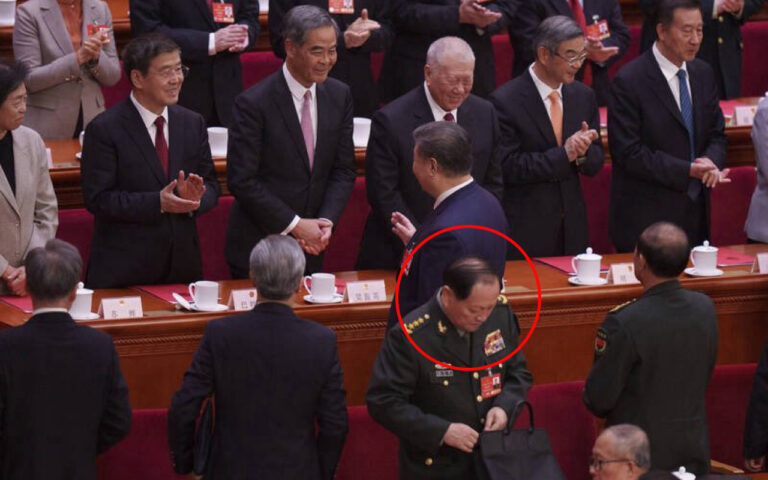
Header image: Zhang Youxia turned his back on Xi Jinping at the 2025 National People’s Congress (CCP).