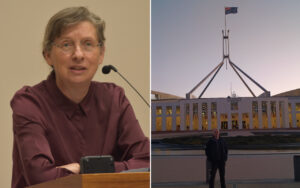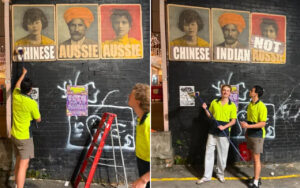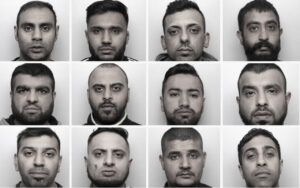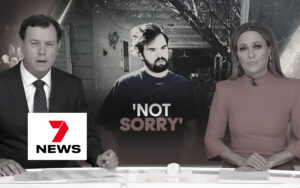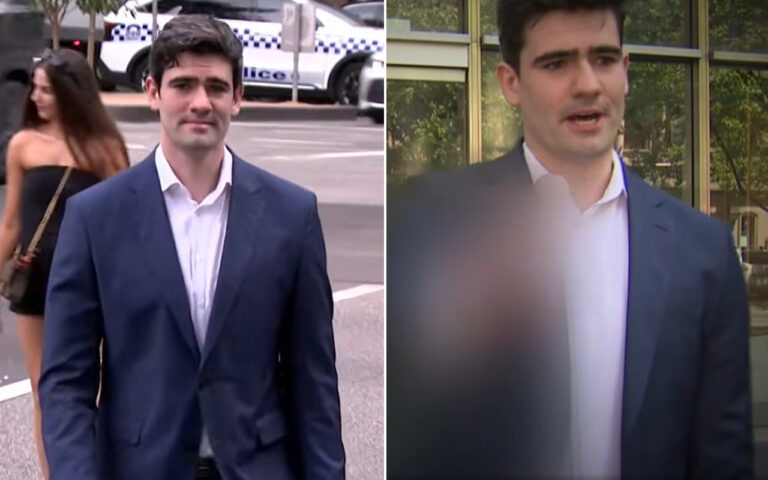
Prominent Australian nationalist Jacob Hersant has lost an appeal against his conviction and jail sentence for performing a Nazi salute outside a Melbourne court.
The National Socialist Network leader, 26, argued during a three-day hearing in the County Court in October that he did not perform the salute, and that Victoria’s Nazi salute laws were invalid as they violated the implied right of all Australians to political communication under the Constitution.
Mr Hersant, a father-of-one, was found guilty and sentenced to one month’s jail in Melbourne Magistrates Court in November last year after making the hand gesture in October 2023 following sentencing over a clash with far-left activists that took place in 2021.
On Friday Judge Simon Moglia handed down his decision, ruling that Mr Hersant was guilty of intentionally performing the salute, and that while his right to political communication had been “effectively burdened”, the laws were necessary to protect Victorians from “harm”.
“In all the circumstances as I’ve set out, I’m satisfied beyond reasonable doubt Mr Hersant intentionally performed a Nazi salute,” he said, Newswire reported.
“I find the accused guilty of the offence charged.”
Mr Hersant, who is on bail, will appear in court again in February for a pre-sentencing hearing, but intends to appeal Judge Moglia’s ruling to the High Court on the same constitutional grounds.
Defence lawyer Timothy Smartt told the court he planned to argue for a sentence reduction for his client on the basis that one month’s imprisonment for a “non-violent act” was inconsistent with other sentences for “far more serious offences”, including domestic violence offenders avoiding jail altogether.
Mr Smartt also told the court he planned to submit that Mr Hersant was the father to a one-year-old child, and was caring for his sick in-laws.
“Mr Hersant is not the first young person to engage in extremist behaviour and he won’t be the last,” he said.
“The community is best served when Mr Hersant isn’t defined by his beliefs and is free to participate in the community.”
Mr Hersant told reporters outside court he could not comment on the case, but when asked if he was a “proud Nazi” said “I am a Nazi, yes”, 9News reported.
During the October hearing, a nine-minute video played to the court showed Mr Hersant and fellow activist Thomas Sewell speaking to reporters outside the same court before Mr Hersant raised his arm partway, lowered it again and said: “Oh, nearly did it, it’s illegal now isn’t it?”
The court heard charges were laid after a 9News cameraman who was filming the pair made a statement to police about his footage.
The prosecution argued that even though Mr Hersant did not perform a “perfect” salute, the arm movement still violated the then-six-day-old ban because “the same harm is caused” by any gesture that could be mistaken for a Nazi salute.
Mr Smartt told the court that his client had not performed a Nazi salute as defined by an expert witness, nor had he intended to perform one, saying that a person dressed as a Nazi hailing a taxi could be found guilty of violating the salute ban if intentionality could be so easily linked to any gesture that resembled a salute.
Counsel for the Attorney-General told the hearing that Victoria’s anti-vilification laws and Nazi symbols and salute bans had either no or a “very small” impact on the implied right to political communication, arguing they “set boundaries for political debate” and “enhanced political communication” by preventing “profound harms suffered by minorities”.
“Hate speech undermines participation by stifling participation, making targeted groups feel intimidated or apprehension about expressing their views in public, people are more likely to take part in public life if they do not feel intimidated or threatened,” she told the court.
She further argued that the Nazi salute laws did not ban Nazi ideology, which she said was in itself “far outside the scope of implied freedom” as it was “incompatible with representative and responsible government”, said the salute was “inextricably linked” to genocide, and told the court that asking for proof of harms done by the gesture would be “re-traumatising” for victims.
Mr Smartt told the court that the Nazi salute could have a range of meanings, but that even on its strongest meaning there was no evidence that it caused harm.
“What harm are we preventing and how are we doing it? No one has told the court this, we just get this very Delphic murmuring that the Nazi salute gives all this harm without any evidence for it, there’s no evidence of any type of how it causes harm,” he said.
He warned that the Nazi salute ban was “breaking new ground” and “takes us down a dark path, that applied in the aggregate, we might not return from”.
“This would be the first offence that targets a political gesture and bans it, this stands to set precedent that the government can do that, which has troubling implications for other gestures and symbols that could be banned,” he told the court.
Mr Smartt then pushed back at the claims that members of minority groups might be “triggered” by seeing a Nazi salute, and told the court there was no evidence that hate speech caused people to disengage with democracy.
“Does hate speech cause minorities to leave public debate or enter it? There’s no evidence, it’s not a factual matter, it’s wrong on a matter of principle and wrong to get into it,’ he told the court.
Mr Smartt went on to ask the court whether the Nazi salute laws were a “way of getting offensive speech banned” as “every person who claims offence, claims harm”.
“What does the law do in this case? It bans Nazi gestures, it doesn’t ban KKK flags, it doesn’t ban other extremely charged gestures, and it’s so far-reaching it applies to other Nazi gestures that haven’t been contemplated or defined,” he told the court.
Mr Smartt then compared the case to Prime Minister Robert Menzies’ 1951 banning of the Communist Party, which was overturned by the High Court.
“Testing the theory of harm by reference to the Communist Party case shows where its flaws are. The great achievement of the case was to expose that kind of reasoning for what it is – reasoning that confuses offence and projects harm into the future without an adequate factual basis,” he said.
“Can we distinguish the cases? The Communist Party case was even more charged and profound. Think about the dark path we would go down by banning political gestures.”
Header image: Left, Mr Hersant outside court on Friday. Right, moment before the salute (9News).